 English
 русский
 Français
 عربى
عربى Español
 Português
 简体中文
简体中文
What Makes a Good University Teaching Desk and Chair?
A good university teaching desk and chair combines four essential qualities: ergonomic adjustability that supports long lecture periods, durable construction that withstands years of intensive daily use, functional design that supports both teaching and note-taking activities, and a stable, safe structure that protects users in high-traffic academic environments. Unlike furniture for casual or occasional use, university teaching furniture is engaged for multiple hours daily by instructors who lecture, write, reference materials, and use technology simultaneously — and by students sitting through 50-to-90-minute class periods. Furniture that fails to address these specific demands directly undermines both teaching effectiveness and student learning outcomes. The sections below break down exactly what separates genuinely good university teaching desk and chair sets from furniture that merely looks adequate in a showroom.
Content
- 1 Why University Teaching Furniture Has Different Requirements Than General Classroom Furniture
- 2 Ergonomic Adjustability: The Foundation of a Good Teaching Desk and Chair
- 3 Durability and Material Quality: Engineering for Intensive Daily Use
- 4 Functional Design Features That Support Effective Teaching
- 5 Stability and Safety: Non-Negotiable Requirements
- 6 Key Selection Criteria: A Practical Comparison Table
- 7 Matching Furniture to Different Teaching Environments
- 8 Maintenance Practices That Preserve Furniture Quality Over Time
- 9 Making the Right Investment Decision
Why University Teaching Furniture Has Different Requirements Than General Classroom Furniture
University teaching environments differ substantially from primary and secondary school classrooms in ways that directly shape furniture requirements. A university lecturer often delivers multiple back-to-back lectures with minimal breaks, frequently standing or transitioning between seated instruction and active presentation. The instructor's desk and chair must support sustained use across a full teaching day — often 4 to 6 hours of continuous classroom contact time — while accommodating laptops, projector remotes, lecture notes, textbooks, and increasingly, dual-monitor or document camera setups.
University lecture halls and seminar rooms also experience far higher furniture utilization rates than typical school classrooms. A single teaching desk in a large lecture hall may be used by 8 to 12 different instructors across a single day in institutions running back-to-back scheduling, compared to a primary school desk used by one teacher throughout the day. This intensive multi-user pattern means university teaching furniture must tolerate more frequent adjustment cycles, more varied user body types, and significantly higher cumulative wear than furniture in lower-turnover environments.
Ergonomic Adjustability: The Foundation of a Good Teaching Desk and Chair
Ergonomic design is not a luxury feature in university teaching furniture — it is a functional necessity directly tied to instructor health, comfort, and teaching performance. Poor posture sustained over years of lecturing is strongly associated with musculoskeletal complaints among teaching staff.
Height Adjustability
A good university teaching chair offers a height adjustment range of approximately 40 to 53 cm from the floor to the seat surface, accommodating the wide range of instructor heights found in any academic population. Pneumatic gas-lift mechanisms are the standard for smooth, tool-free adjustment and should support repeated daily adjustment cycles without degradation — quality mechanisms are rated for tens of thousands of adjustment cycles over their service life.
The teaching desk itself should ideally also offer height adjustment, particularly in modern lecture environments that mix seated and standing instruction. A desk surface adjustable between approximately 72 and 120 cm accommodates both traditional seated lecturing and the standing-desk teaching style increasingly adopted in active learning classrooms (Source: Cornell University Ergonomics Web, Workstation height guidelines for seated and standing work).
Lumbar Support and Backrest Design
Given the extended sitting periods many instructors experience between lectures, lumbar support is a critical chair feature. A contoured backrest that supports the natural inward curve of the lower spine reduces the compressive load on lumbar discs during prolonged seated periods. Backrest recline adjustability — typically a range of 15 to 25 degrees — allows instructors to shift posture during longer sessions, which research on prolonged sitting consistently associates with reduced musculoskeletal discomfort compared to fixed, upright-only seating positions.
Armrests and Seat Depth
Adjustable armrests support the forearms during writing or typing tasks at the teaching desk, reducing shoulder and neck strain. Seat depth adjustability, while less common, benefits the wide range of body proportions found among university faculty — a seat that is too deep forces users to either sit without back support or experience pressure behind the knees, both of which compromise comfort during long teaching sessions.
Durability and Material Quality: Engineering for Intensive Daily Use
University teaching furniture experiences significantly higher cumulative use than residential or even most office furniture. A teaching desk and chair used across a typical academic calendar will accumulate substantial operating hours, and the materials and construction methods used directly determine whether the furniture remains functional and presentable for its intended service life.
Frame Construction
Steel-framed chairs and desks with welded joints (rather than bolted-only construction) resist the loosening and wobble that develops in lower-quality furniture after repeated use. A steel frame using tubing with a wall thickness of 1.2 mm or greater provides substantially better long-term structural integrity than thinner-walled alternatives, particularly at stress points like chair leg-to-seat connections and desk frame corners.
Powder-coat finishes, applied through electrostatic spray and cured at high temperature, provide superior scratch and corrosion resistance compared to liquid paint — a meaningful consideration given that university furniture is regularly moved, cleaned with commercial cleaning products, and subject to constant contact wear from clothing, bags, and equipment.
Desktop and Surface Materials
The desktop surface of a university teaching desk must withstand daily writing, equipment placement, and frequent cleaning. High-density particleboard or MDF substrates with melamine or laminate surfacing offer strong resistance to scratching, staining, and moisture, provided edge banding is properly sealed to prevent moisture penetration at exposed edges — a common failure point in lower-quality furniture. Surfaces should also resist common contaminants encountered in academic settings: dry-erase marker residue, coffee spills, and the oils from repeated hand contact.
Expected Service Life
A well-constructed university teaching desk and chair set, properly maintained, typically achieves a service life of 10 to 15 years in regular institutional use — a meaningfully longer lifespan than budget furniture, which often requires replacement within 3 to 5 years due to frame failure, surface degradation, or mechanism wear. Given the procurement cycles and budget planning typical of university facilities departments, this difference in service life has a direct and substantial impact on total cost of ownership across a campus-wide furniture inventory.
Functional Design Features That Support Effective Teaching
Beyond ergonomics and durability, a genuinely good university teaching desk and chair set incorporates design features that directly support the practical activities instructors perform during class delivery.
Desk Surface Area and Layout
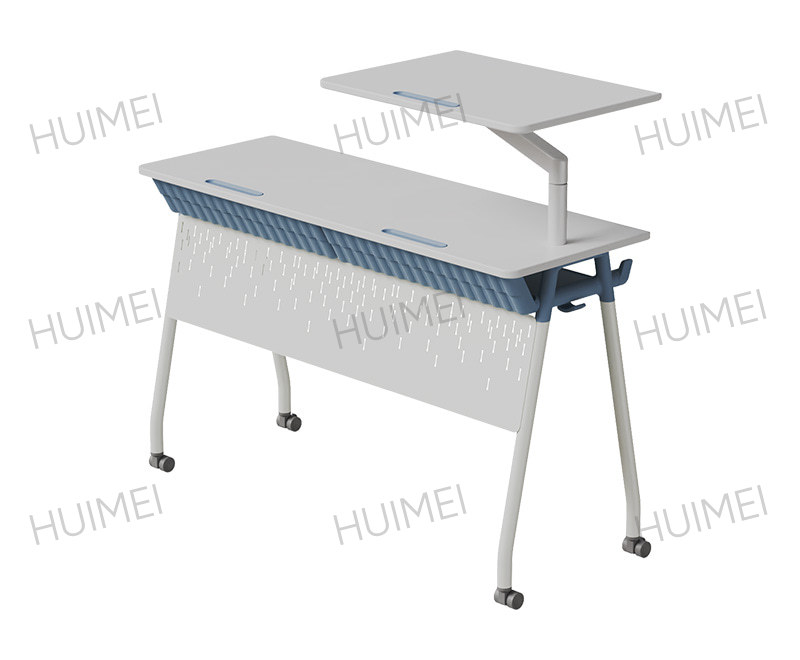
A teaching desk needs sufficient surface area to accommodate a laptop or desktop computer, lecture notes or textbooks, a document camera or visualizer in some institutions, and personal items such as a water bottle or mobile device — without requiring the instructor to constantly rearrange materials mid-lecture. A surface area of approximately 1.2 to 1.5 metres in width by 0.6 metres in depth provides adequate working space for typical lecture delivery without requiring an oversized footprint that would crowd the front of a classroom or lecture hall.
Cable Management
Modern university teaching relies heavily on connected technology: laptops, document cameras, microphones, and classroom AV systems. A well-designed teaching desk includes integrated cable management — grommets, channels, or routing clips — that keeps power and data cables organized and prevents the tangled cable hazards that create both a tripping risk and a constant minor disruption to lecture flow. Desks lacking this feature force instructors and IT staff to improvise solutions, often with adhesive cable ties or loose routing that degrades over time.
Storage Provision
Built-in storage — drawers, shelving, or a lockable compartment — allows instructors to keep teaching materials, markers, adapters, and personal items secured and organized at the teaching station. In shared teaching environments where multiple instructors use the same room across a day, lockable storage is particularly valuable for protecting personal equipment between sessions.
Mobility Considerations
In flexible learning spaces designed for varied teaching formats — lecture, seminar discussion, group work — teaching desks with locking casters allow instructors to reposition the desk to suit different activities while maintaining stability once positioned. Quality locking casters should hold position reliably under the desk's full loaded weight without unintended movement during use, a feature that becomes especially important as universities increasingly adopt flexible, reconfigurable classroom layouts.
Stability and Safety: Non-Negotiable Requirements
Stability is a foundational safety requirement for any furniture used in a high-traffic academic environment where students and instructors move through the space continuously between classes.
Structural Stability Under Load
A teaching chair should maintain stability under dynamic loading — instructors leaning to reach materials, shifting weight during extended standing-to-sitting transitions, or briefly resting weight on an armrest while gesturing. Five-point caster bases on rolling chairs provide significantly better tip-resistance than four-point designs, distributing load across a wider stability footprint. Static load testing for institutional seating commonly targets a minimum sustained load capacity of 110 to 135 kg, ensuring the chair safely accommodates the full range of body weights among university faculty (Source: BIFMA X5.1, American National Standard for Office Chairs — General Purpose Office Chairs).
Tip and Collision Resistance
A stable teaching desk should resist tipping even when a moderate lateral or downward force is applied to one edge — a realistic scenario given that instructors frequently lean on the desk surface while teaching. Desk base width and weight distribution should be engineered to prevent tipping under foreseeable use conditions, an especially important consideration for height-adjustable desks where a raised desktop creates a higher centre of gravity.
Edge and Corner Safety
In high-traffic teaching spaces, rounded or chamfered edges and corners on both desk and chair components reduce injury risk from incidental contact during the constant movement that characterizes lecture hall and seminar room environments between classes. Sharp 90-degree edges, common in lower-cost furniture, present an avoidable hazard that quality university furniture design eliminates as a standard feature.
Key Selection Criteria: A Practical Comparison Table
The table below summarizes the practical difference between minimally adequate furniture and genuinely good university teaching desk and chair specifications, providing a useful reference for procurement evaluation.
| Specification Area | Minimum Adequate Standard | Good University Standard |
|---|---|---|
| Chair height adjustment range | Fixed or limited adjustment | 40 to 53 cm adjustable range |
| Lumbar support | Flat or minimal backrest contour | Contoured, adjustable lumbar support |
| Frame tube wall thickness | Below 1.0 mm | 1.2 mm or greater |
| Desktop surface treatment | Basic laminate, unsealed edges | Sealed edge banding, scratch-resistant laminate |
| Cable management | None or improvised | Integrated grommets and routing channels |
| Static load capacity (chair) | Below 100 kg | 110 to 135 kg or higher |
| Expected service life | 3 to 5 years | 10 to 15 years |
| Storage provision | None | Drawer or lockable compartment |
| Comparison reflects typical market differences between budget and quality-tier institutional teaching furniture specifications | ||
Matching Furniture to Different Teaching Environments
Not every university teaching space has identical furniture requirements. Matching the specific desk and chair configuration to the room type improves both functionality and budget efficiency.
Large Lecture Halls
In large lecture halls serving 100 or more students, the teaching desk is typically a fixed or semi-fixed installation positioned near integrated AV control systems. Priorities here include robust cable management for connecting to centralized classroom technology, sufficient desktop area for document cameras and control panels, and a chair that supports several consecutive hours of lecturing across multiple back-to-back class sessions.
Seminar and Discussion Rooms
Smaller seminar rooms benefit from more mobile, reconfigurable teaching furniture that can be repositioned to suit discussion-based formats, group work, or traditional lecturing within the same space across different class sessions. Locking casters and lighter-weight but still durable construction are particularly valuable here.
Laboratory and Technical Teaching Spaces
Laboratory teaching environments often require desks with chemical-resistant or more easily cleaned surface materials, and chairs that can withstand more frequent height adjustment as instructors move between standing demonstration and seated instruction. Stability is an even higher priority in these settings given the additional equipment often present.
Selecting furniture that addresses the specific demands of each teaching environment, rather than applying a single generic specification across an entire campus, ensures that the furniture investment genuinely supports the teaching activities occurring in each space. The University Teaching Desk and Chair series from Huimei is designed with this range of institutional teaching environments in mind, offering configurations suited to lecture, seminar, and technical teaching applications within a consistent quality and design standard.
Maintenance Practices That Preserve Furniture Quality Over Time
Even well-specified furniture requires appropriate maintenance to achieve its full service life potential in a high-use university environment.
- Routine cleaning with appropriate products: Use cleaning agents recommended by the furniture manufacturer for the specific surface material; harsh solvents or abrasive cleaners can degrade laminate and powder-coat finishes prematurely
- Periodic mechanism inspection: Check gas-lift height adjustment mechanisms, tilt mechanisms, and locking casters at least annually to identify wear before it leads to functional failure
- Fastener tightening: Frame joints and hardware connections should be checked and tightened periodically, as the repeated movement and adjustment cycles typical of teaching furniture can gradually loosen fasteners over time
- Prompt repair of minor damage: Addressing small issues — a loose caster, a minor surface scratch, a slightly misaligned drawer — before they worsen prevents minor wear from developing into furniture-ending structural problems
- Seasonal deep cleaning: Between academic terms, when classrooms see reduced use, is an ideal time for more thorough cleaning and inspection of all teaching furniture across a department or building
Making the Right Investment Decision
For university facilities and procurement teams, the decision to invest in quality teaching desk and chair sets should be evaluated against total cost of ownership rather than upfront unit cost alone. Furniture that lasts 10 to 15 years rather than 3 to 5 years effectively reduces replacement frequency by a factor of three or more across the same period — a difference that compounds significantly when multiplied across the dozens or hundreds of teaching stations a typical university campus maintains.
Beyond the direct cost calculation, the ergonomic and functional quality of teaching furniture has a measurable relationship to instructor wellbeing and, by extension, teaching consistency and quality. Faculty who experience physical discomfort from poorly designed seating during back-to-back teaching sessions are demonstrably less able to deliver consistent energy and engagement across a full teaching day. Investing in furniture engineered specifically for the demands of university-level instruction — properly adjustable, genuinely durable, thoughtfully functional, and structurally safe — is therefore both a facilities decision and an investment in teaching quality across the institution.
When evaluating options for an upcoming furniture procurement cycle, prioritizing documented specifications over showroom appearance, verifying load ratings and material quality claims, and selecting a University Teaching Desk and Chair series built specifically for the intensity of institutional academic use will deliver far better long-term value than furniture selected primarily on initial price or aesthetic appeal alone.
Copyright© Zhejiang Huimei Industry & Trade Co., Ltd. All Rights Reserved.
Professional School Furniture Manufacturer School Furniture Supplier