 English
 русский
 Français
 عربى
عربى Español
 Português
 简体中文
简体中文
What is Mobile Small Table?
A mobile small table is a compact, wheeled table unit designed to be moved freely from one location to another without requiring tools or physical relocation effort. Unlike fixed desks or conventional tables, a mobile small table is mounted on casters — typically lockable swivel wheels — that allow the entire unit to be rolled, repositioned, and stabilized wherever it is needed at any given moment. Most models combine a flat working surface with one or more integrated storage tiers, shelves, or drawers beneath the tabletop, making them a versatile hybrid between a table and a storage rack. Mobile small tables are used across a wide range of settings: school classrooms, office environments, medical facilities, libraries, laboratories, retail spaces, and home study or workrooms. Their defining characteristic is the ability to serve a practical working or storage function in one location and then be repositioned — quickly and without effort — to serve a completely different function in another location, all within the same space or across different rooms.
Content
- 1 The Core Design Concept Behind Mobile Small Tables
- 2 Mobile Small Table vs. Conventional Table: Key Differences
- 3 Types of Mobile Small Tables and Their Specific Functions
- 4 Where Mobile Small Tables Are Most Commonly Used
- 5 What to Look for in a Quality Mobile Small Table
- 6 Mobile Small Table with Storage Rack: The Most Practical Configuration
- 7 Benefits of Mobile Small Tables Compared to Fixed Furniture in Flexible Environments
- 8 How to Choose the Right Mobile Small Table for Your Environment
- 9 Summary: What Makes a Mobile Small Table the Right Furniture Choice
The Core Design Concept Behind Mobile Small Tables
The fundamental design concept of a mobile small table resolves a problem that conventional furniture cannot: the need for a functional, dedicated work or storage surface in a space that must serve multiple different purposes at different times. A fixed table occupies its footprint permanently; a mobile small table occupies only the footprint it currently needs to occupy and can be cleared from the space entirely in seconds.
This concept is not new — mobile utility trolleys have existed in professional environments such as hospitals and laboratories for generations — but the modern mobile small table refines the idea considerably. Contemporary designs integrate ergonomic working heights, refined aesthetics compatible with educational and office interiors, robust construction capable of decades of institutional use, and practical storage features that make the unit genuinely useful rather than merely movable. The result is a piece of furniture that functions as a full working station when needed and a compact, out-of-the-way storage unit when not.
Key Structural Features
- Caster wheels: Typically 4 to 6 dual-wheel or single-wheel casters mounted on the legs or base frame, allowing smooth rolling across hard floors and low-pile carpet; locking mechanisms on at least two casters prevent movement once the table is positioned
- Compact footprint: Mobile small tables are specifically dimensioned to fit through standard doorways, navigate between desks, and occupy minimal floor space when parked in a storage position; typical table surface dimensions range from approximately 40 x 50 cm to 60 x 80 cm
- Integrated storage tiers: Most designs include at least one additional shelf or tray beneath the main tabletop, and many incorporate two or three storage levels, providing organized space for books, equipment, supplies, or personal items without requiring a separate storage unit
- Structural frame: Steel tube or powder-coated steel frames are standard for institutional-grade mobile small tables, providing the rigidity needed to support working loads without flex or wobble when the unit is in use
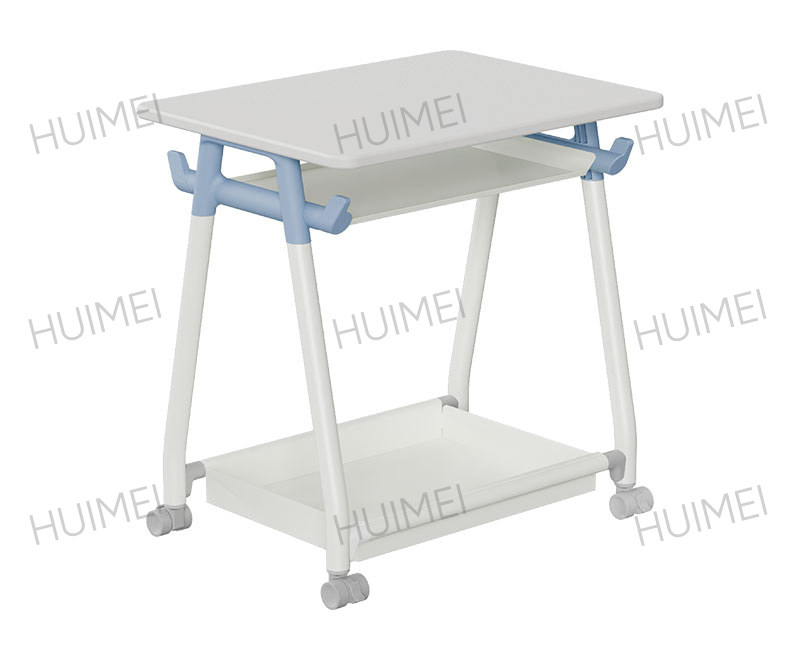
Mobile Small Table vs. Conventional Table: Key Differences
Understanding how a mobile small table differs from a conventional fixed or portable table clarifies which applications are best served by each furniture type and why mobile small tables have become increasingly specified in flexible-use environments.
| Feature | Conventional Fixed Table | Mobile Small Table |
|---|---|---|
| Mobility | Fixed; requires lifting or carrying to move | Rolls freely on casters; repositioned by one person |
| Floor space occupation | Permanent footprint at fixed location | Flexible; can be parked away when not needed |
| Integrated storage | Usually none beneath the work surface | One to three shelves or trays built in |
| Multi-environment use | Limited to its fixed location | Can serve different spaces in the same facility |
| Reconfiguration speed | Requires physical effort and time | Seconds, by a single unaided user |
| Typical size | Varies widely, often larger | Compact; designed for one-person use and easy navigation |
| Suitability for active learning / flexible office | Limited | High; supports rapid layout changes |
| Comparison of conventional fixed tables and mobile small tables across key functional dimensions for flexible-use institutional environments | ||
Types of Mobile Small Tables and Their Specific Functions
Mobile small tables are produced in several distinct configurations, each optimized for a specific primary use case while sharing the core characteristic of wheeled mobility.
Mobile Small Table with Storage Rack
The mobile small table with integrated storage rack is the most functionally versatile configuration and the most widely used in educational settings. This design combines a writing or working surface at standard desk height with two or more open shelves below, creating a unit that provides a personal workspace, book storage, supply organization, and a bag or backpack hanging point — all in a single compact footprint that rolls into position at the beginning of a class and can be stacked or parked efficiently when not in active use.
In primary and secondary school environments, mobile small tables with storage racks allow teachers to reorganize classroom layouts quickly for different activity types — group discussion, individual project work, or direct instruction — without requiring students to carry separate materials between locations. The storage tier keeps individual students' books and materials at hand throughout the school day, reducing time lost to retrieval and organization at each activity transition.
The Mobile Small Table cart and storage rack series is specifically engineered for this application, combining a robust steel frame construction with a practical multi-tier layout designed to meet the daily demands of busy classroom environments.
Mobile Utility Cart Table
The mobile utility cart table prioritizes load-bearing capacity and durability over aesthetics, and is commonly used in laboratories, workshops, medical facilities, and industrial environments. These units typically have heavier-gauge steel frames, higher caster load ratings, and surfaces finished in chemical-resistant or easy-clean materials suited to technical work environments. Multiple shelves at different heights allow organized storage of equipment, supplies, and consumables that must be brought to the point of use rather than retrieved from fixed storage during work processes.
Mobile Teacher or Presenter Table
Mobile presenter tables are designed for use by a teacher, trainer, or presenter who needs a working surface and technology support point — for a laptop, tablet, projector, or document camera — that can be repositioned during the session to suit the activity or the audience configuration. These units often incorporate cable management features, a lower shelf for equipment bags or accessories, and a surface area large enough to accommodate technology alongside reference materials.
Mobile Bedside or Patient Table
In healthcare environments, mobile small tables serve as adjustable-height bedside working surfaces that allow patients to eat, write, or use devices while in bed, and can be swung or rolled out of the way during care procedures. The mobility and compact footprint of these units are essential in hospital room environments where multiple pieces of medical equipment compete for limited floor space around the patient bed.
Where Mobile Small Tables Are Most Commonly Used
The practical advantages of mobile small tables have led to their adoption across a diverse range of environments, each of which places different demands on the furniture but benefits from the same core characteristic of wheeled mobility combined with a working surface and integrated storage.
School and University Classrooms
Educational environments are the most significant application area for mobile small tables, driven by the global shift toward flexible, activity-based learning that requires classroom furniture to support rapid layout reconfiguration. Research on classroom design consistently links flexible furniture arrangements with improved student engagement and learning outcomes. A study published by the University of Salford found that classroom physical design — including furniture flexibility — accounted for approximately 16% of the variation in learning progress among primary school students, making it one of the most significant environmental factors within a school's control (Source: Clever Classrooms, University of Salford, 2015).
Mobile small tables allow students to move from row-based listening arrangements to group work clusters to individual project stations within the same lesson period, without the disruption and time loss associated with rearranging conventional fixed furniture. Their storage tiers keep materials organized and at hand throughout these transitions, reducing the time spent locating and distributing resources that would otherwise interrupt lesson flow.
Office and Corporate Environments
Modern open-plan offices and activity-based working environments increasingly specify mobile furniture that can be configured differently depending on the work being done at any given time. Mobile small tables serve as individual side tables for laptop work, as shared reference surfaces adjacent to standing desks or meeting points, and as portable workstations that employees can bring to collaborative zones or quiet areas as needed. The shift toward hybrid working has intensified demand for furniture that can support rapidly changing space utilization patterns without requiring physical infrastructure changes.
Libraries and Learning Resource Centers
Library and learning resource center environments use mobile small tables to create flexible study and research spaces that can be quickly reconfigured for individual study, group project work, or events and presentations. Mobile tables with integrated book shelves or device storage tiers are particularly practical in library contexts, where users often need to work with multiple reference materials alongside digital devices and personal items simultaneously.
Medical and Healthcare Facilities
In hospitals, clinics, and care facilities, mobile tables serve as bedside working surfaces, medication preparation surfaces, equipment transport vehicles, and patient communication or activity stations. Their mobility is essential in environments where floor space is frequently reconfigured around patient care activities and where equipment must be brought to the point of care rather than requiring patients or staff to travel to fixed stations.
Home Workrooms and Domestic Use
In residential settings, mobile small tables serve as flexible additions to home offices, craft rooms, children's study spaces, and living areas. Their compact dimensions make them practical in smaller homes where a permanent dedicated desk in every room is impractical, and their mobility allows a single unit to serve as a workspace in the morning and a surface-clearing storage unit in the evening when the same room must serve a different social function.
What to Look for in a Quality Mobile Small Table
Not all mobile small tables are built to the same standard, and in institutional environments where furniture is subjected to heavy daily use by many users over extended periods, construction quality has a direct impact on the total cost of ownership and the reliability of the furniture in daily use.
Frame Material and Wall Thickness
The structural frame is the single most important determinant of a mobile small table's long-term durability. Steel tube frames with a wall thickness of 1.2 mm or greater provide significantly better resistance to bending, joint fatigue, and structural deformation under repeated loading than thinner-walled alternatives. Powder-coat finishes applied by electrostatic spray and cured at high temperature provide superior adhesion and corrosion resistance compared to liquid paint, extending the frame's appearance and structural integrity across years of intensive institutional use.
Caster Quality and Load Rating
Casters are among the highest-wear components on any mobile furniture piece and are often the first point of functional failure. Quality casters for institutional mobile tables should be rated for the total loaded weight of the table plus its contents — typically a minimum of 50 to 75 kg per caster for standard educational applications — and should include a positive-locking mechanism on at least two of the four or more casters to prevent unintended movement when the table is in use. Dual-wheel casters provide better stability and floor protection than single-wheel designs and are preferred for use on the vinyl, laminate, and hard flooring surfaces common in institutional environments.
Working Surface Quality
The tabletop surface must resist the daily wear of writing, equipment placement, spills, and cleaning with commercial cleaning products. Melamine-faced or high-pressure laminate (HPL) surfaces offer strong scratch, stain, and moisture resistance for educational and office applications. Edge banding quality is particularly important — exposed panel edges without adequate banding allow moisture penetration that causes the substrate to swell and delaminate over time. For environments where chemical resistance is required, specialist surface coatings or solid material surfaces may be specified in place of standard laminate.
Storage Tier Design
The integrated storage tiers should be sized and positioned to serve the actual storage needs of the target users. For student applications, the lower shelf should comfortably accommodate A4 or letter-size books and binders (requiring a minimum clear height of approximately 30 cm and a depth of at least 25 cm). Wire mesh or open construction shelves allow visual inventory of contents without requiring items to be removed, which is particularly useful in fast-moving classroom environments where time spent locating materials is a genuine productivity issue.
Load Capacity and Stability
A quality mobile small table for institutional use should be rated to support a minimum static tabletop load of 50 kg without flex or structural distortion, with a safety factor appropriate for dynamic loading from writing and working activities. The unit must remain stable under moderate lateral pressure — such as a student leaning on the table edge — without tipping or rolling. A wider wheelbase relative to table height improves tip resistance, and locking casters are essential for ensuring the unit does not creep during use on smooth floors.
Mobile Small Table with Storage Rack: The Most Practical Configuration
Among the various mobile small table configurations, the version with an integrated storage rack has emerged as the most widely adopted in educational and office environments because it most effectively addresses the combination of needs users actually have: a working surface, organized storage immediately to hand, and the ability to reposition the entire unit without effort.
The mobile small table cart and storage rack configuration typically provides:
- A primary working surface at a height compatible with seated or standing use depending on the model, providing adequate area for writing, device use, or project work
- A mid-level storage shelf at a height accessible from the seated position, suitable for books, binders, or a laptop bag
- A lower storage tier near floor level, suitable for backpacks, larger items, or overflow materials that do not need to be accessed frequently during the session
- Hook or hanging points on the frame sides in some models, providing additional space for bags, headphones, or accessories without occupying shelf space
- Casters with individual locking mechanisms, allowing the unit to be rolled freely when repositioning and locked securely in position during use
This configuration creates an effective personal workstation that can be personalized by the individual user — with their specific materials, devices, and supplies organized across the storage tiers — and then rolled into precisely the arrangement the current activity requires. The Mobile Small Table with cart and storage rack design from Huimei embodies these principles, providing a well-engineered solution for schools, offices, and other flexible-use institutional environments that need furniture as adaptable as the activities taking place within them.
Benefits of Mobile Small Tables Compared to Fixed Furniture in Flexible Environments
The advantages of mobile small tables over fixed furniture alternatives are most pronounced in environments where space use patterns change frequently, where multiple different activities must occur in the same physical space, or where the demographic of users changes regularly — as in classrooms, training rooms, and shared office spaces.
Space Efficiency Through Reconfiguration
Mobile small tables allow the same floor area to support more different configurations than fixed furniture, effectively increasing the functional versatility of the space without increasing its physical size. A classroom equipped with mobile small tables can be arranged in rows for direct instruction, clusters for group work, a U-shape for seminar discussion, or a fully cleared configuration for presentations or physical activities — all within the same lesson period, by the students themselves, in under two minutes. This versatility is impossible with fixed desks and represents a genuine spatial efficiency advantage that justifies the investment in mobile furniture over fixed alternatives in multi-use environments.
Reduced Furniture Inventory Requirements
In facilities with multiple rooms or areas that need occasional working surfaces — but not permanent dedicated desks in every space — mobile small tables can be shared between spaces, rolling from one room to another as needed. This reduces the total number of furniture pieces required across the facility, which has a direct positive impact on total furniture procurement cost. A stock of mobile small tables that can serve five different rooms on a rotating basis can replace a much larger inventory of fixed furniture that would otherwise need to be maintained in every room at all times.
Lower Installation and Infrastructure Cost
Fixed furniture — particularly built-in desks or workstations — requires installation work, and any subsequent repositioning requires significant effort or professional installation assistance. Mobile small tables require no installation at all: they arrive assembled, are positioned by users without tools or specialist knowledge, and can be repositioned or removed entirely without any impact on the building structure or flooring. For facilities undergoing frequent reorganization, renovation, or changes in use, this installation-free flexibility represents a genuine lifecycle cost advantage over fixed furniture alternatives.
Supporting Ergonomic and Inclusive Design
Mobile small tables with adjustable-height mechanisms or available in multiple height options allow a single furniture type to serve users of different physical sizes, including wheelchair users and students with mobility requirements who may need a surface positioned at a different height or accessible from a different angle than standard fixed desks provide. The ability to position a mobile table from any side — rather than requiring the user to fit the table's fixed orientation — also supports more inclusive, accessible classroom and office layouts.
How to Choose the Right Mobile Small Table for Your Environment
Selecting the correct mobile small table for a specific application requires matching the product specification to the actual conditions of use — the user population, the surface types in the facility, the typical loads the table will carry, and the aesthetic requirements of the space.
- Define the primary use scenario: A mobile small table for a primary school classroom has different requirements from one for a hospital bedside or a corporate office — establish the dominant use case before evaluating specific product options
- Check the table surface height against user ergonomics: Standard seated working height is typically 72 to 76 cm for adult users; for primary school students, heights in the range of 52 to 68 cm are more appropriate depending on age group
- Verify caster suitability for the floor type: Hard rubber or polyurethane casters are suitable for most hard floor surfaces; softer compounds are needed for vinyl or sensitive flooring; confirm that the caster load rating matches or exceeds the expected loaded weight of the table plus contents
- Assess the storage configuration against actual storage needs: Count the books, devices, and supplies a typical user will need to store at the unit and match the shelf count, dimensions, and total storage volume to that requirement
- Confirm frame and surface material specifications: Request the steel tube wall thickness, surface laminate specification, and edge banding details; these determine how long the unit will maintain its function and appearance in intensive use
- Evaluate the stacking or parking efficiency: In environments where multiple mobile small tables must be stored compactly when not in use, confirm how the units nest or stack together and what space is required to store a full classroom set
- Consider the total cost of ownership: A higher initial purchase price for a better-specified unit will typically deliver a lower cost per year of service in institutional environments where furniture is used intensively across many years
Summary: What Makes a Mobile Small Table the Right Furniture Choice
A Mobile Small Table is the right furniture choice whenever a space must serve multiple different activity patterns, whenever users need a personal working surface and storage solution that moves with them rather than requiring them to move to it, or whenever a facility needs to maximize the functional versatility of its floor area without increasing its physical size. The combination of wheeled mobility, compact footprint, integrated storage, and durable construction makes mobile small tables uniquely suited to the demands of modern flexible-use educational, professional, and healthcare environments — and a practical, cost-efficient alternative to fixed furniture in any setting where adaptability is valued over permanence.
As classroom design, office planning, and healthcare facility management all continue to evolve toward greater flexibility and user-centered layouts, the mobile small table with integrated storage rack occupies an increasingly central role in the furniture systems that support these environments — small in footprint, large in practical value, and genuinely flexible in the ways that matter most to the people who use them every day.
Copyright© Zhejiang Huimei Industry & Trade Co., Ltd. All Rights Reserved.
Professional School Furniture Manufacturer School Furniture Supplier