 English
 русский
 Français
 عربى
عربى Español
 Português
 简体中文
简体中文
What is a whiteboard?
A whiteboard is a smooth, reusable writing surface—typically white or light-coloured—on which users write with dry-erase markers and erase the content cleanly with a cloth or eraser, leaving no permanent marks. Whiteboards are the modern replacement for chalk blackboards and are standard equipment in classrooms, offices, meeting rooms, training facilities, and homes worldwide. Unlike paper or notepads, a whiteboard allows content to be written, discussed, modified, and erased repeatedly without consuming any consumable material beyond the markers themselves—making it an efficient, sustainable, and highly flexible communication and visual thinking tool.
The term "whiteboard" covers a wide family of products—from small tabletop boards and personal desktop versions to large wall-mounted panels spanning 3 metres or more, and increasingly, digital interactive whiteboards that combine a physical writing surface with touchscreen and connected display technology.
Content
- 1 How a Whiteboard Works: The Dry-Erase Principle
- 2 Types of Whiteboard Surfaces: What They Are Made Of
- 3 Types of Whiteboards by Form and Installation
- 4 Whiteboard Surface Type Comparison: Key Differences at a Glance
- 5 Primary Uses of Whiteboards: Where and Why They Are Used
- 6 Key Accessories and What Makes Them Matter
- 7 How to Choose the Right Whiteboard for Your Needs
How a Whiteboard Works: The Dry-Erase Principle
The key to a whiteboard's functionality lies in the relationship between the writing surface and the marker ink. Dry-erase markers contain ink formulated with a release agent—typically a silicone polymer or similar compound—that prevents the pigment from bonding permanently to the board surface. When the marker dries, the ink adheres only weakly to the surface, allowing it to be wiped away cleanly with a dry cloth, felt eraser, or paper towel.
The writing surface itself is non-porous, which is what makes erasure possible. Porous surfaces like paper and uncoated drywall absorb marker ink into their fibre structure, where it bonds and cannot be removed without a solvent. A properly specified whiteboard surface—whether glass, melamine, lacquered steel, or porcelain enamel—has no pores for the ink to penetrate, so the weakly adhering dried ink film can be mechanically removed in a single wipe.
Why Whiteboards Ghost and Stain Over Time
"Ghosting" is the faint residual impression of previous writing that remains after erasure. It occurs when microscopic scratches in the writing surface trap ink pigment that cannot be wiped out. The harder and smoother the surface, the more resistant it is to scratching and ghosting. Low-cost melamine whiteboards develop visible scratches from eraser abrasion within months of daily use; high-end porcelain enamel surfaces resist scratching for decades. Using permanent markers—which contain ink without a release agent—on a whiteboard causes immediate staining that cannot be removed by dry erasing and requires a solvent or whiteboard cleaner to address.
Types of Whiteboard Surfaces: What They Are Made Of
The writing surface material is the most important determinant of a whiteboard's quality, durability, and long-term performance. Five surface types cover the majority of whiteboards available in the market.
Melamine
Melamine whiteboards have a melamine resin-coated paper surface laminated to a substrate such as particleboard or MDF. They are the most common and least expensive type—suitable for light home and classroom use. The surface is reasonably smooth when new but develops micro-scratches relatively quickly under regular erasing, leading to ghosting and staining within 1 to 3 years of daily use in a busy environment. Melamine boards are not magnetic and are best suited to occasional rather than intensive use.
Lacquered Steel (Magnetic)
Lacquered steel whiteboards use a painted or coated steel sheet as the writing surface, mounted on a backing board. Because the core material is steel, the board surface is magnetic—it will hold standard magnets and magnetic accessories such as marker holders, document clips, and data card holders. Lacquered steel boards are durable and suitable for office and educational environments, with a typical service life of 5 to 10 years under regular use. The surface is harder than melamine but softer than porcelain, making it moderately resistant to ghosting.
Porcelain Enamel (Vitreous Enamel)
Porcelain enamel whiteboards are manufactured by fusing glass-based enamel onto a steel substrate at high temperatures. The result is an extremely hard, non-porous, scratch-resistant surface that is also magnetic. Porcelain enamel boards are the premium standard for intensive professional and educational use, with manufacturers typically offering 25-year or lifetime warranties on the writing surface. They resist ghosting, staining, and denting far better than lower-tier alternatives and are the appropriate specification for conference rooms, schools, and training facilities where boards are used multiple times daily.
Glass
Tempered glass whiteboards offer the hardest, smoothest, and most visually premium writing surface available. Glass is inherently non-porous and resists scratching better than any coated surface, which means it effectively never ghosts and cleans perfectly with a single wipe for decades of use. Glass whiteboards are not magnetic in their basic form (though magnetic glass variants with a steel backing layer are available) and are significantly more expensive than other types. They are increasingly used in premium office and collaborative workspace environments where the aesthetic contribution of the board is as important as its functional performance.
Painted Drywall and Whiteboard Paint
Whiteboard paint—a specialist coating applied to any smooth, primed wall surface—transforms an entire wall into a dry-erase surface at significantly lower cost per square metre than panel whiteboards. Quality whiteboard paint products create a usable dry-erase surface for 5 to 10 years when properly applied and maintained. Performance varies significantly by product quality; lower-grade paints ghost quickly and stain permanently with heavy-pigment markers.
Types of Whiteboards by Form and Installation
Beyond the surface material, whiteboards vary significantly in their physical form and how they are installed or used. Understanding the different form factors helps match the right whiteboard to the specific context.
Wall-Mounted Whiteboards
The most common configuration for classroom and meeting room use. Wall-mounted boards range from small 600 × 900 mm units for home offices to large 1,200 × 3,600 mm panels for lecture theatres and training rooms. They provide a fixed, stable writing surface at a height calibrated for standing use by adults. Many wall-mounted boards are available in a magnetic surface variant, enabling documents, photos, and card systems to be pinned to the board with magnets as part of a visual management or planning system.
Mobile and Easel Whiteboards (Free-Standing)
Mobile whiteboards stand on adjustable legs or frames fitted with lockable castors, allowing them to be repositioned anywhere in a room or moved between rooms without tools. Many are double-sided, providing two writing surfaces in the footprint of one board. Mobile boards with 1,200 × 900 mm or 1,500 × 1,000 mm writing surfaces are standard in corporate and educational settings where writing surfaces need to be shared across multiple spaces or reconfigured for different meeting formats. Some models include a shelf for storing markers and erasers, and a cross-shaped or H-shaped base for stability during writing.
Desktop and Tabletop Whiteboards
Compact personal whiteboards designed to sit on a desk or table for individual use. They range from very small notebook-sized boards to medium desktop panels of approximately 400 × 300 mm. Desktop whiteboards are used for personal task lists, quick notes, brainstorming scratch pads, and in educational settings where students write answers for the teacher to check simultaneously—a technique called "show me" boards or student response boards. Some desktop whiteboard designs integrate a tabletop and whiteboard into a single furniture piece, with the board surface forming the desk surface itself—a useful configuration for collaborative studio and maker environments.
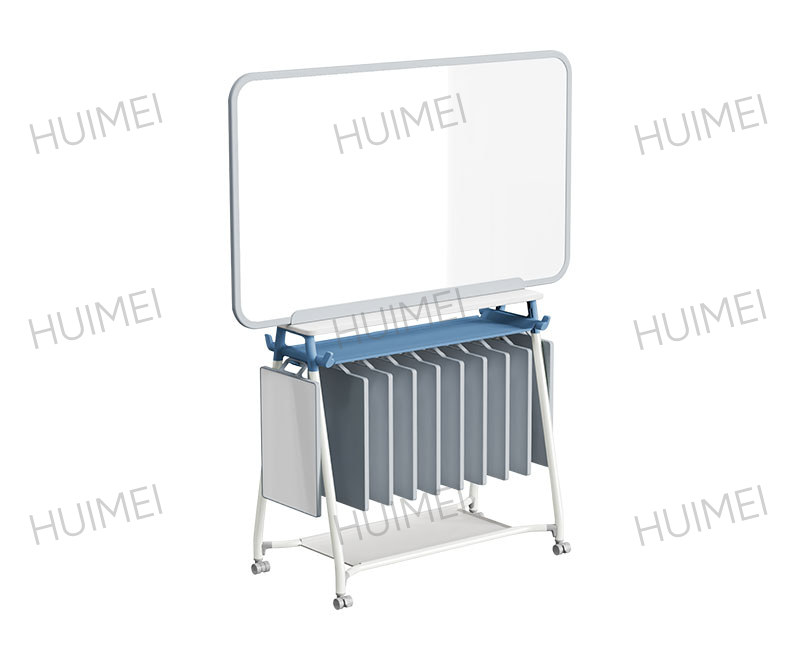
Rolling Whiteboard with Storage Shelf
A hybrid design that combines a writing surface with practical storage—a shelf or tray below the board surface holds books, notebooks, equipment, or supplies. This configuration is common in professional training rooms, design studios, and collaborative offices where the whiteboard is used as part of a broader work setup and storage nearby is valuable. Double-sided models with storage below the board and adjustable feet or castor wheels provide a complete, self-contained mobile workstation with a writing surface on both sides.
Interactive Digital Whiteboards
Interactive whiteboards—also called smart boards or interactive flat panel displays (IFPDs)—combine a large touchscreen display with whiteboard-like annotation capability and full computer connectivity. Content can be written, drawn, saved, shared, and projected from the same surface. They are increasingly standard in K-12 classrooms and corporate conference rooms equipped for hybrid meetings. The writing surface is typically a tempered glass panel over an LED display, and the "ink" is digital rather than physical marker ink.
Whiteboard Surface Type Comparison: Key Differences at a Glance
| Surface Type | Ghosting Resistance | Magnetic | Typical Lifespan | Relative Cost | Best For |
|---|---|---|---|---|---|
| Melamine | Low | No | 1–3 years | Low | Home, light use |
| Lacquered steel | Moderate | Yes | 5–10 years | Moderate | Office, classroom |
| Porcelain enamel | Very High | Yes | 25+ years | High | Schools, training rooms |
| Glass | Highest | Optional | Decades | Premium | Premium offices |
| Whiteboard paint | Moderate–Low | No | 5–10 years | Low per m² | Large wall coverage |
Primary Uses of Whiteboards: Where and Why They Are Used
Whiteboards serve a remarkably wide range of functions across different environments, and the reasons they are used consistently across such different settings reflect genuine functional advantages over alternatives.
Education and Teaching
Whiteboards replaced chalk blackboards in most schools and universities from the 1990s onward. The advantages are significant: no chalk dust (better for air quality and for students with asthma or dust allergies), brighter white surface that reflects light rather than absorbing it (easier to read from the back of a classroom), multiple marker colours that are more vivid than chalk, and no residual dust on clothing and hands. A standard classroom whiteboard is typically 1,200 × 2,400 mm or larger, positioned at the front of the room at a height accessible to both standing teachers and seated viewers.
Business Meetings and Collaboration
In office meeting rooms, whiteboards enable real-time collaborative thinking that is not possible with a presentation slide deck. Ideas, process flows, decision frameworks, diagrams, and brainstorming outputs can be captured visually as the discussion develops, modified immediately when participants push back or refine ideas, and preserved at the end of the meeting by photographing the board. Research on collaborative working consistently finds that groups who can externalise their thinking onto a shared visible surface reach better outcomes faster than groups working only from verbal discussion—this is the core reason whiteboards are a standard feature of meeting rooms globally.
Agile and Project Management
Kanban boards, sprint planning boards, and task management walls are implemented using whiteboards with columns drawn or taped in place, populated with sticky notes or magnetic cards representing tasks. This physical implementation of project management systems is deliberately preferred by many teams over digital equivalents because the board is always visible, requires no device or login to update, and creates a shared physical artefact that the whole team owns collectively. A 1,800 × 1,200 mm magnetic whiteboard provides sufficient space for a complete Kanban system for a team of 6 to 10 people.
Design Thinking and Brainstorming
Design studios, innovation labs, and creative agencies rely heavily on large whiteboard surfaces—often covering entire walls—for mapping user journeys, sketching interface designs, drawing system architectures, and running structured ideation sessions. The speed and ease of drawing on a whiteboard, combined with the ability to erase and iterate without any friction, makes it the preferred medium for early-stage conceptual work where speed of thought matters more than polish.
Personal Organisation and Home Use
Small whiteboards are widely used at home for grocery lists, family calendars, to-do lists, homework tracking, and meal planning. A 450 × 600 mm magnetic whiteboard in a kitchen or home office provides a persistent visual reminder system for daily tasks that is faster to update than a digital app and visible without any screen interaction. Children's whiteboards—both standalone easel versions and smaller personal boards—are common educational tools for practicing writing, arithmetic, and drawing at home.
Key Accessories and What Makes Them Matter
A whiteboard without the right accessories is significantly less useful. The following accessories are standard or strongly recommended for effective whiteboard use.
- Dry-erase markers — the most important accessory; quality varies significantly between brands. Look for markers that erase cleanly, do not bleed to the adjacent area, and have good colour vibrancy. Chisel-tip markers allow both fine and broad strokes from the same marker. Replace markers before they begin to scratch—a dried-out marker with a hardened tip will damage even a good-quality surface.
- Felt eraser — a quality eraser removes dry-erase ink without smearing across the board. Foam-backed erasers or microfibre erasers clean more thoroughly with less pressure than cheap felt pads, reducing surface scratching over time.
- Whiteboard cleaning spray — essential for removing ghosting, dried marker residue, and accidental permanent marker marks. Apply weekly on heavily used boards and immediately whenever ghosting is noticed; cleaning ink residue before it hardens preserves surface quality significantly longer.
- Magnets and magnetic accessories — for magnetic surface boards, a set of coloured magnets and magnetic pen holders allows documents, photos, notes, and cards to be displayed alongside written content without tape or pins that damage the surface.
- Grid or planning templates — printed acetate overlays or reusable grid templates positioned on or behind the board surface help users draw consistent grids, timelines, and process flows without needing to measure manually.
- Marker tray and shelf — most whiteboards include a ledge below the writing surface for resting markers and erasers. For mobile or rolling boards, ensuring the marker tray is securely attached and does not tip when the board is moved avoids the common problem of markers rolling off and drying out uncapped on the floor.
How to Choose the Right Whiteboard for Your Needs
Selecting the most appropriate whiteboard requires matching five key parameters to the actual use case. Getting these decisions right at the point of purchase prevents the frustration of a board that ghosts within months, lacks space for the intended use, or cannot be positioned correctly in the available room.
- Determine usage intensity — a board used twice a week in a home office can be melamine; a board used multiple times daily in a school or conference room needs lacquered steel at minimum and porcelain enamel ideally. Buying a melamine board for intensive commercial use is a false economy that leads to replacement within 1 to 2 years.
- Choose the right size for the room and user count — a general rule: allow approximately 300 to 400 mm of horizontal board width per person who will simultaneously write on the board. A 4-person team meeting needs at least 1,200 to 1,600 mm of board width. For a classroom, the board should be readable from the back row—text must be at least 50 mm high to be legible at 8 metres distance.
- Decide between wall-mounted and mobile — if the board will always be used in the same location, wall-mounting provides stability and saves floor space. If the board needs to be used in different rooms or repositioned within a room for different meeting formats, a mobile board with castor wheels is essential.
- Assess whether magnetic capability is needed — if you plan to use magnets to hold documents, cards, or accessories, the board must have a steel-backed magnetic surface. Melamine boards are not magnetic; glass boards require a special magnetic variant with an additional steel layer.
- Consider the mounting height — the bottom edge of the writing area should be at approximately elbow height for the primary users when standing; for a mixed-height group or for use by children, lower mounting or an adjustable-height mobile board is preferable. For classrooms, a mounting height of approximately 800 to 900 mm from the floor to the bottom edge suits most adult-height users.
Copyright© Zhejiang Huimei Industry & Trade Co., Ltd. All Rights Reserved.
Professional School Furniture Manufacturer School Furniture Supplier