 English
 русский
 Français
 عربى
عربى Español
 Português
 简体中文
简体中文
What are the main features of Canteen One-Piece Dining Table and Chairs?
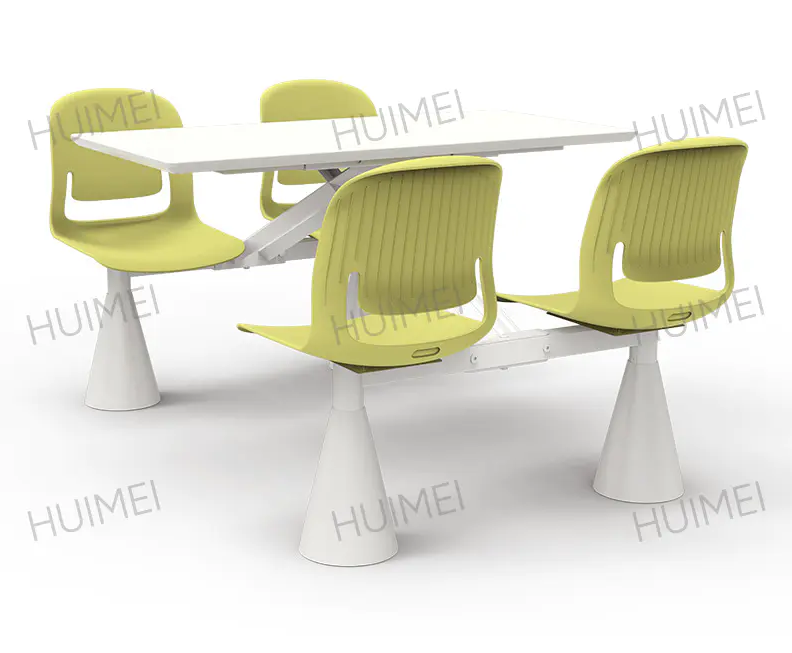
The main features of canteen one-piece dining table and chairs are structural integration, durability, space efficiency, and ease of maintenance. Unlike separate table and chair combinations, one-piece (or fixed-seat) canteen furniture connects the seating directly to the table frame as a single structural unit. This design eliminates loose chairs that can be moved, stacked carelessly, or lost, making it the preferred choice for high-traffic institutional dining environments such as school cafeterias, factory canteens, hospital dining halls, and fast-food restaurants where throughput, hygiene, and long-term cost of ownership are the primary procurement criteria.
Content
Integrated One-Piece Structure
The defining characteristic of canteen one-piece dining furniture is that the seats, table top, and supporting frame are manufactured and assembled as a unified structure rather than as separate components.
- Fixed-seat configurations are typically available in 2-seat, 4-seat, 6-seat, and 8-seat arrangements, with the seats cantilevered or bracket-mounted directly to the central table pedestal or side frame rails.
- The integrated design eliminates connection joints between table and chair, which are the most common failure points in separate furniture sets under repeated heavy use.
- Because the entire assembly behaves as one structural unit, load is distributed across the full frame rather than concentrated at individual chair legs — significantly improving resistance to rocking and tipping under uneven loading.
- Many designs incorporate floor-mounted or wall-anchored bases, further locking the unit in place and preventing movement during busy service periods.
High-Durability Materials for Institutional Use
Canteen one-piece dining sets are constructed from materials selected specifically for longevity under the demands of institutional environments, where a single unit may serve hundreds of users per day across a service life of 10–20 years.
Frame Materials
- Powder-coated steel is the most common frame material, offering high tensile strength, resistance to deformation under load, and a corrosion-resistant surface finish. Heavy-gauge steel frames (typically 1.5–3 mm wall thickness) are used in high-load applications such as factory canteens.
- Stainless steel (304 or 316 grade) frames are specified for food-service environments requiring chemical resistance to cleaning agents and corrosion resistance in humid or wet kitchen-adjacent areas.
- Galvanized steel frames are used in outdoor canteen settings, providing rust protection without requiring paint maintenance.
Table Top and Seat Surface Materials
- High-pressure laminate (HPL) table tops offer scratch resistance, stain resistance, and a wide range of color and texture options. HPL surfaces withstand repeated wiping with commercial cleaning solutions without surface degradation.
- Solid wood or wood veneer surfaces are used in canteens where a warmer aesthetic is required, such as corporate dining facilities or hospitality environments.
- Molded plastic (polypropylene or ABS) seats are highly impact-resistant, waterproof, and easily cleaned with standard disinfectants — making them the most common seat surface material in school and hospital canteens.
- Upholstered foam seats with vinyl or PVC covering are used in settings where user comfort over longer meal periods is prioritized, such as corporate cafeterias or employee dining rooms.
Space Efficiency and Layout Optimization
One of the most practically important features of canteen one-piece furniture is its ability to maximize the number of dining positions within a given floor area. Because chairs cannot be pulled out or pushed at angles, the effective footprint per seat is predictable and consistent.
- A standard 4-seat canteen one-piece unit typically occupies a footprint of approximately 120 × 80 cm, achieving a per-seat area of around 0.24 m² — significantly more space-efficient than separate table and chair arrangements, which typically require 0.4–0.6 m² per seat to allow chair movement.
- Fixed units can be arranged in rows with minimal aisle widths since users slide in and out from the ends, rather than pulling chairs back into the aisle. This layout is particularly effective in long, narrow canteen spaces.
- For outdoor canteen or campus settings, permanently anchored one-piece units eliminate the need for furniture storage space — there is no requirement to stack or store chairs when the space is not in use.
Ease of Cleaning and Hygiene Maintenance
In food service environments, the ability to clean surfaces quickly and thoroughly between seatings is a critical operational requirement. Canteen one-piece dining sets are specifically designed to support efficient cleaning routines.
- No loose components means cleaning staff do not need to lift, move, or reposition chairs before wiping down tables. This can reduce per-table cleaning time by 30–50% compared to separate furniture configurations.
- Smooth, non-porous seat and table surfaces (plastic, HPL, or stainless steel) do not absorb food residues or cleaning chemicals, supporting thorough sanitation with standard food-safe disinfectants.
- Many designs feature rounded corners and radiused edges on both the table top and seat surfaces, eliminating sharp-edged crevices where food debris can accumulate.
- Floor-mounted base designs with open underframe areas allow mop heads and floor-cleaning equipment to pass beneath the unit without obstruction, maintaining floor hygiene under the table.
Safety and Stability Features
Safety is a primary design consideration for canteen furniture used by large numbers of people across all age groups and physical abilities.
- Anti-tip stability — the wide base span of a one-piece unit, often spanning the full table width, makes it inherently more resistant to tipping than individual chairs. Floor-anchored versions are completely tip-proof.
- No loose chair legs — separate chair legs are a leading cause of trip-and-fall incidents in busy canteens. Fixed-seat designs eliminate this hazard entirely.
- Non-slip foot pads or floor anchors — rubber-tipped feet or bolt-down floor anchors prevent the unit from sliding on smooth canteen floor surfaces during use.
- Load capacity — commercial-grade canteen one-piece units are typically rated for a static seat load of 120–150 kg per seat and tested to withstand dynamic loading (simulating users sitting down forcefully) without structural deformation.
- Edge and corner finishing — all exposed metal edges are rolled, deburred, and powder-coated or capped to prevent cuts or abrasions during normal use.
Configuration Options and Customization
Canteen one-piece dining sets are available in a range of standard configurations, and most manufacturers offer customization to match specific space dimensions, user demographics, or aesthetic requirements.
| Configuration | Typical Dimensions (L × W) | Seat Height | Common Application |
|---|---|---|---|
| 2-seat | 80 × 60 cm | 43–46 cm | Compact canteens, corridors, fast-food counters |
| 4-seat | 120 × 75 cm | 43–46 cm | School cafeterias, factory canteens |
| 6-seat | 180 × 75 cm | 43–46 cm | Hospital dining halls, university canteens |
| 8-seat | 240 × 75 cm | 43–46 cm | Large institutional canteens, military mess halls |
| Children's (4-seat) | 100 × 65 cm | 32–36 cm | Primary school canteens, kindergartens |
Beyond seating count, customization options typically include table top color and material, seat color, frame finish (powder coat color or stainless finish), with or without backrest on seats, and floor-mounted versus free-standing base configurations.
Long-Term Cost Advantages Over Separate Furniture
While the upfront purchase price of a canteen one-piece unit is typically higher than equivalent separate tables and chairs, the total cost of ownership over a 10-year period consistently favors the integrated design in high-use institutional settings.
- No chair replacement costs — in institutional environments, individual chairs typically require replacement every 3–5 years due to damage, loss, or wear. One-piece units eliminate this recurring cost entirely.
- Reduced labor for room setup and cleanup — there is no requirement to arrange, align, or restack chairs between meal periods, reducing cleaning and setup labor time by an estimated 15–25 minutes per service period in a typical 50-seat canteen.
- Lower maintenance frequency — with fewer movable parts and connection joints, one-piece units require significantly less ongoing maintenance than separate furniture assemblies, where chair-to-floor contact points and frame joints typically need tightening or re-welding after 2–3 years of heavy use.
- Reduced damage and vandalism — in publicly accessible canteens such as those in schools or transit facilities, chairs are frequently damaged through misuse. Fixed-seat designs are substantially harder to damage or vandalize than free-standing chairs.
Copyright© Zhejiang Huimei Industry & Trade Co., Ltd. All Rights Reserved.
Professional School Furniture Manufacturer School Furniture Supplier