 English
 русский
 Français
 عربى
عربى Español
 Português
 简体中文
简体中文
Rolling Standing Desk Guide: Stability, Height Range, and Buying Tips for Schools
A rolling standing desk looks like a simple idea: a height-adjustable tabletop on casters. In a shared school lab, a faculty office, or a dorm study room, that simplicity can turn into daily frustration if the wheels do not lock, the frame flexes, or the height range misses the people who need it. The conclusion first: for most education and office settings, buy a rolling standing desk only when wheel lock, frame stiffness, and a documented height range are treated as non-negotiable. Mobility is a bonus, not the main feature.
Content
- 1 Why a Rolling Standing Desk Earns Its Space
- 2 The Four Specifications That Decide Daily Use
- 3 How to Test Stability Without a Showroom
- 4 Where Rolling Standing Desks Fit in Schools and Shared Offices
- 5 Rolling vs Fixed Standing Desk: A Practical Comparison
- 6 Buying Checklist for Institutions and Multi-User Spaces
- 7 Common Mistakes and How to Avoid Them
Why a Rolling Standing Desk Earns Its Space
The appeal is practical. A single rolling standing desk can serve a teacher who grades papers in the morning, a student who needs a standing option in the afternoon, and a staff member who uses it for a short project in the evening. Instead of buying three fixed desks, a school or office can buy one mobile unit and move it to where the work is. That flexibility matters in older buildings where rooms are small and power outlets are scarce.
Standing work also breaks up long sitting periods. But the health benefit only appears when the desk is actually used. If the wheels stick, the top wobbles, or adjusting the height takes both hands and a firm kick, people will leave it parked in a corner. The best rolling standing desk is the one that feels solid enough to forget it has wheels.
The Four Specifications That Decide Daily Use
| Specification | Target or check | Why it matters | Common mistake |
|---|---|---|---|
| Height range | At least 28-48 in (71-122 cm) | Covers seated and standing use for short and tall users | Buying a laptop-only riser that cannot reach standing height |
| Wheel lock | Two locking casters minimum, preferably four | Prevents rolling during writing, typing, or lab work | Assuming all casters lock; many only swivel |
| Frame stiffness | No visible sway when you press the front edge | Reduces monitor shake and frustration | Choosing a light frame for easy moving, then hating the wobble |
| Work surface depth | 24-30 in (61-76 cm) for a laptop plus notebook | Keeps screen at a safe distance and leaves room for tasks | Using a shallow 18 in top that feels cramped |
Height range is the first filter. A desk that stops at 42 in (107 cm) may work for a 5 ft 6 in user but not for a 6 ft 2 in colleague. A range that starts at 28 in (71 cm) also lets seated users type with their elbows near 90 degrees. Wheel lock is the second filter because a rolling desk that will not stay put is a safety issue in a classroom. Frame stiffness is harder to judge online, so look for a wide base, a crossbar, or a C-frame design that resists side-to-side motion.
How to Test Stability Without a Showroom
You do not need a laboratory to separate a stable rolling standing desk from a wobbly one. Use a five-minute routine with the desk unloaded, then repeat it with a typical load such as a laptop, a monitor, and a stack of books.
- Lock every caster. If the desk still moves when you push it gently, the brakes are too weak for daily use.
- Press down on the front edge with one hand. A small flex is normal; a visible bounce of the whole top is not.
- Push the desk from the side while the casters are locked. The frame should not twist more than a few degrees.
- Raise the desk to its highest setting. Shake the top lightly. If a monitor would sway, the desk is better suited to seated work.
- Roll the desk over a threshold or a carpet edge. If you need to lift it, the wheels are too small for your floor.
These checks also reveal electrical and pinch-point risks. Powered desks should have a low-voltage control box and a thermal cut-off. Pneumatic or crank models avoid cables but may need more effort per adjustment. For multi-user settings, a powered desk with two or three memory presets saves time and reduces arguments about the correct height.
Schools and training centers often need furniture that can adapt to different activities during the same day. A rolling standing desk can support a science demo in the morning, a group project after lunch, and a staff meeting in the late afternoon. In a library, it can become a quiet standing spot for catalog work or a temporary checkout station. In an administrative office, it can supplement a fixed desk for tasks that are easier to do while standing.
The same movement-and-height logic appears in other school furniture. A mobile, rechargeable, detachable, and adjustable podium, for example, is designed to be wheeled between rooms, locked in place, and set to a comfortable working height. That kind of product shows how mobility and stability can coexist when the frame and locking system are engineered together.
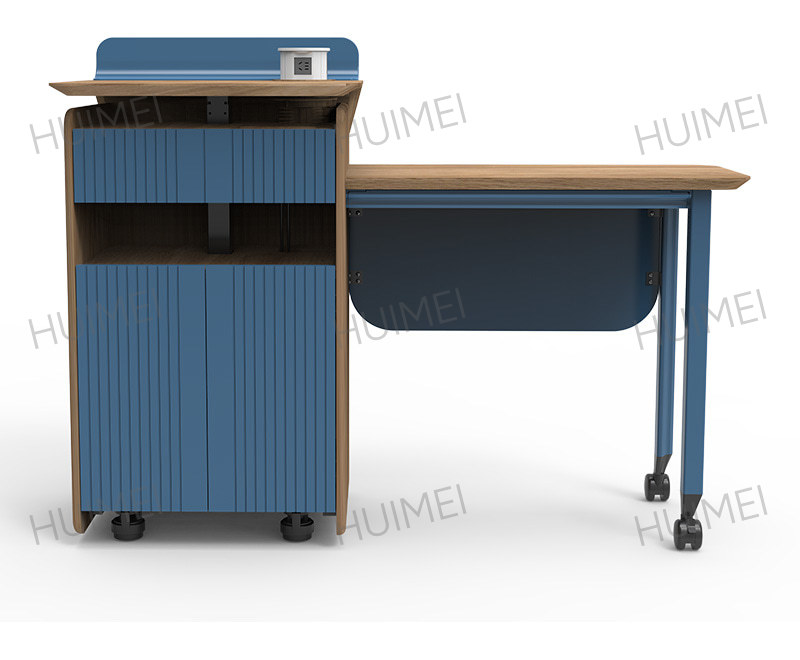 Mobile Rechargeable Detachable Adjustable Podium for Teaching and PresentationsA wheeled podium with lift adjustment, storage, and optional charging, designed to move between classrooms while locking stably for teaching and presentations.View Product →
For storage and smaller mobile work surfaces, a mobile small table, cart, or storage rack can also reduce clutter in classrooms and offices. It is not a standing desk, but it solves the same underlying problem: keeping tools and materials ready without permanently occupying floor space.
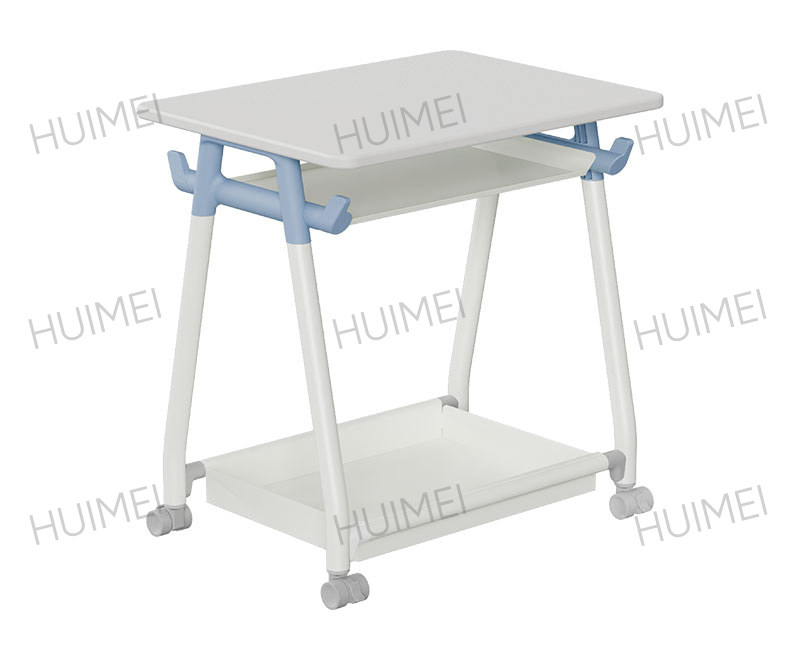 Mobile Small Table Cart and Storage Rack for Flexible ClassroomsA movable classroom furniture unit combining table, cart, and storage to help reconfigure layouts and keep teaching materials organized.View Product →
Rolling vs Fixed Standing Desk: A Practical Comparison
| Factor | Rolling standing desk | Fixed standing desk | Practical impact |
|---|---|---|---|
| Mobility | High; moves between rooms and zones | Low; stays in one place | Rolling units suit shared spaces and changing tasks |
| Stability | Depends on wheel lock and frame design | Usually more stable because it is anchored | Fine motor tasks or heavy monitors may favor fixed desks |
| Price | Higher due to casters and lift mechanism | Lower for a simple frame | Budget planning should include maintenance, not just purchase price |
| Space use | Can be pushed against a wall when not in use | Occupies the same footprint all day | Small rooms gain flexibility with a rolling desk |
| Maintenance | Castors, brakes, and lift columns need checks | Fewer moving parts | Schools should assign a simple monthly inspection |
The trade-off is not rolling versus standing. It is mobility versus stability. If a desk will move at least once a week, a rolling model can be worth the extra cost and maintenance. If it will stay in one office for years, a fixed standing desk is usually the more reliable choice.
Buying Checklist for Institutions and Multi-User Spaces
- Confirm the height range covers the shortest and tallest expected users, not just the average.
- Ask for the wheel diameter and brake type. Casters under 2 in (5 cm) struggle on carpet and thresholds.
- Check the load rating with the lift fully extended, not only at the lowest position.
- Look for a flat, easy-clean work surface and rounded edges for classroom safety.
- Request a sample of the frame finish and the caster material if the desk will be cleaned daily.
- Plan a simple inspection routine for loose bolts, brake wear, and cable damage.
For schools and training centers, the supplier matters as much as the specification. A manufacturer that already produces classroom desks, dormitory furniture, library tables, and office seating understands how a rolling standing desk will be used alongside other equipment. Zhejiang Huimei Industry & Trade Co., Ltd. is an educational equipment manufacturer in Wuyi County, Zhejiang, with products covering teaching furniture, dormitory furniture, library furniture, dining furniture, and educational office furniture. Its experience with height-adjustable classroom desks and mobile school furniture is relevant when a rolling desk must fit a wider campus plan.
Ergonomic details also deserve attention. The company has published notes on how ergonomics can improve teaching and learning, which is a useful reminder that a desk is only one part of a healthy workspace.
For more context on the manufacturer, see the company background, and for a related discussion on furniture and learning, see ergonomics in teaching and learning.
Common Mistakes and How to Avoid Them
One common mistake is buying a rolling standing desk for a single tall user and then discovering that shorter colleagues cannot use it comfortably. Another is choosing a model with small casters because it looks less industrial, only to find that it catches on every floor mat. A third is ignoring the cost of maintenance. Casters and lift columns are wear items, so a cheap desk can become expensive after two years of daily movement.
A modular office desk or a height-adjustable workstation can be a better fit when the primary need is a fixed individual workspace rather than a shared mobile unit. Modular desks can be combined with monitor arms, storage, and privacy screens, while a rolling standing desk remains the better option for hot-desking, temporary projects, and rooms that change function during the day.
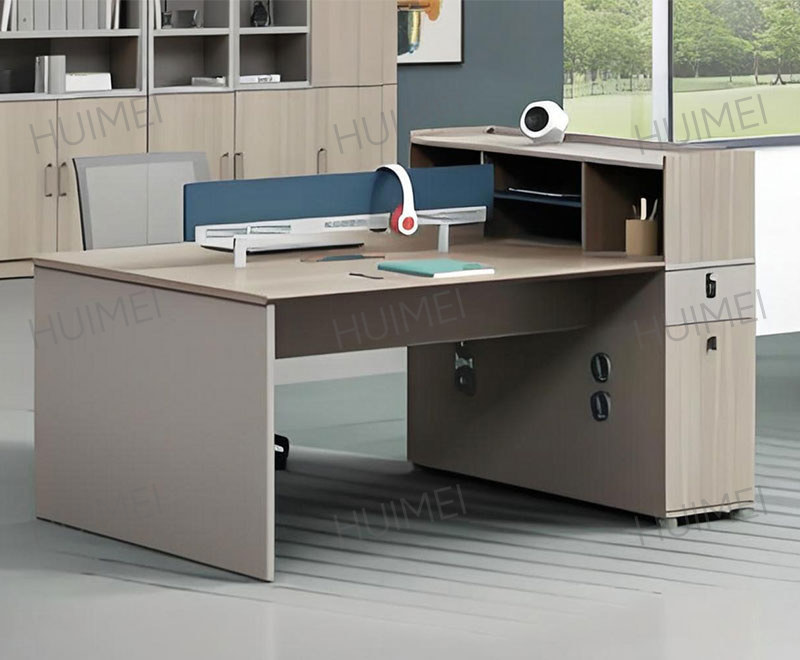 Screen Style Modular Office Desk with Embedded StorageA modular office desk for fixed individual workspaces, in screen, executive, and embedded-storage styles with E1 particleboard and melamine veneer.View Product →
A rolling standing desk is not a magic solution for every workspace. It is a tool that rewards careful specification. Prioritize a height range that fits real users, locking casters that hold on your floor, and a frame that stays steady at standing height. Then test it with the same load it will carry every day. If it passes those checks, the wheels become an asset rather than a liability, and the desk earns the space it takes up.
Copyright© Zhejiang Huimei Industry & Trade Co., Ltd. All Rights Reserved.
Professional School Furniture Manufacturer School Furniture Supplier