 English
 русский
 Français
 عربى
عربى Español
 Português
 简体中文
简体中文
Portable Standing Laptop Desk Guide: Stability, Height Range, and Right Fit
A teacher who works in three different rooms, a clinic nurse who documents on the move, and a renter who works against a 2.4 m wall all run into the same problem: a fixed desk sits in the wrong place for most of the day. A portable standing laptop desk turns the work surface into something you push, park and lock. The complaints about these desks are rarely about the idea itself. They are about wobble at standing height, casters that slide away while you type, and a height range that stops a few centimeters short of a comfortable typing position.
So here is the short answer before the detail: buy on height range, caster quality and base geometry first, and on appearance last. Everything else, including the price, is secondary to those three.
Content
- 1 The Three Specifications That Decide Everything
- 2 Four Formats and Where Each One Fits
- 3 Stability, Tolerances and the Wobble Test
- 4 A Buying Checklist for Schools, Clinics and Home Offices
- 5 Setting It Up So People Actually Use It
- 6 Planning Mobile Work Surfaces Across a Campus
- 7 Questions Buyers Ask Most
The Three Specifications That Decide Everything
Start with height range. A person of average height standing at a laptop needs the keyboard surface roughly 950 mm to 1150 mm above the floor, with the forearms level and the elbows close to 90 degrees. Taller users need the top of that band or more; shorter users need the desk to come down to about 950 mm without the frame bottoming out. If the same desk is also used for sitting, it has to reach 650 mm to 750 mm. A model that covers 700 mm to 1050 mm looks generous on paper but leaves a 185 cm user typing with rounded shoulders.
Then check the load rating, and read carefully whether it is a static or a moving figure. A laptop weighs 1.5 kg to 2.5 kg, a 24 inch monitor 3 kg to 6 kg, a clamp-on arm another 2 kg to 4 kg, and notes, a lamp and a water bottle add roughly 2 kg. Those items consume a 15 kg nominal rating very quickly. For a desk that will be pushed around with equipment on top, plan for a 25 kg to 30 kg rating and treat the published number as 30 to 40 percent lower once the desk is rolling.
Finally, look at the base. A T-leg or C-leg base with feet 500 mm to 600 mm deep resists side loading far better than a single-column pedestal of the same height. The smaller the floor footprint, the more the desk depends on a low center of gravity and on casters that can actually be locked.
Four Formats and Where Each One Fits
Most products sold as mobile or portable standing desks fall into four groups, and they are not interchangeable. A narrow rolling laptop desk and a mobile standing workstation solve different problems, even when their photographs look similar.
| Format | Typical surface height | Practical load | Best use | Main risk |
|---|---|---|---|---|
| Rolling laptop desk, single column | 700 mm to 1150 mm | 10 kg to 20 kg | Home office, bedside, small consultation rooms | Narrow top tips if the user leans on the edge |
| Mobile standing workstation, T or C base | 950 mm to 1250 mm | 25 kg to 40 kg | Shared offices, laboratories, teaching spaces | Larger footprint, cable runs must be planned |
| Mobile podium or lectern cart | 1000 mm to 1250 mm | 20 kg to 30 kg | Classrooms, training rooms, hybrid lectures | Sloped or shallow top, check laptop and document fit |
| Overbed or side table on casters | 600 mm to 1000 mm | 5 kg to 15 kg | Care settings, dormitories, reading corners | Height often fixed or limited, not built for standing |
Stability, Tolerances and the Wobble Test
Mobility and rigidity pull against each other. A desk standing 1100 mm tall on a 600 mm base is a lever, and every joint in the column adds a little movement. A useful benchmark for a laptop desk is lateral movement of less than about 10 mm when a 5 kg load is pressed sideways against the top edge. Anything beyond that shows up as a screen that shakes while you type.
Caster size matters more than most buyers expect. Casters of about 50 mm roll well on tile, vinyl and hardwood but can increase pushing effort by 50 to 70 percent on low-pile carpet. Casters of 75 mm or more handle carpet, door thresholds and cable covers with far less effort, and they also raise the desk slightly, which needs to be included in the height calculation. Locking brakes on at least two casters are sufficient for a laptop, but four brakes are worth requesting for corridors, laboratories and any room where children move around.
Frame and top construction set the service life. Steel tube walls of 1.2 mm to 2.0 mm, welded corner joints rather than rivets, and 18 mm to 25 mm laminate tops with PVC edge banding survive years of being pushed between rooms. Powder-coated finishes resist chipping at the points where knees and door frames make contact.
A Buying Checklist for Schools, Clinics and Home Offices
Procurement risk on this product category is rarely about price per unit. It is about buying a model that cannot be serviced, cannot be adjusted for the tallest and shortest user, or cannot be repaired when a caster fails. The same reasoning appears in the classroom desk and chair selection guide, where height coverage is the first filter rather than an afterthought.
- Measure the standing and sitting height of the tallest and shortest user, then buy a desk that covers both extremes, not the average.
- Confirm whether the load rating is static or dynamic, and derate the published figure for rolling use.
- Match caster material to the floor: soft polyurethane for hard floors, larger and softer wheels for carpet.
- Order two spare casters for every ten desks, because casters fail before frames do.
- Check the base depth and total footprint, including whether the desk fits through a classroom door and around desk rows.
- Ask for cable management hooks or a tray. Trailing power leads are the most common trip hazard in shared spaces.
- Confirm assembly time, required tools and whether spare parts will be available for the production run of the model.
- Verify the warranty in writing and check that the finish and top material suit daily movement, not occasional repositioning.
Setting It Up So People Actually Use It
A mobile desk only improves posture if the screen and keyboard are placed correctly. With the desk at standing height, the top of the screen should sit at eye level, which usually means raising the laptop on a stand or adding an external monitor and using a separate keyboard at the desk surface. Typing directly on a laptop placed at standing height forces the wrists up and the neck down, which defeats the purpose of the purchase.
Alternating between standing and sitting every 30 to 45 minutes works better than standing all morning. That routine needs a chair that adjusts across the same range as the desk, with a seat height that lets the feet rest flat and the elbows stay near 90 degrees.
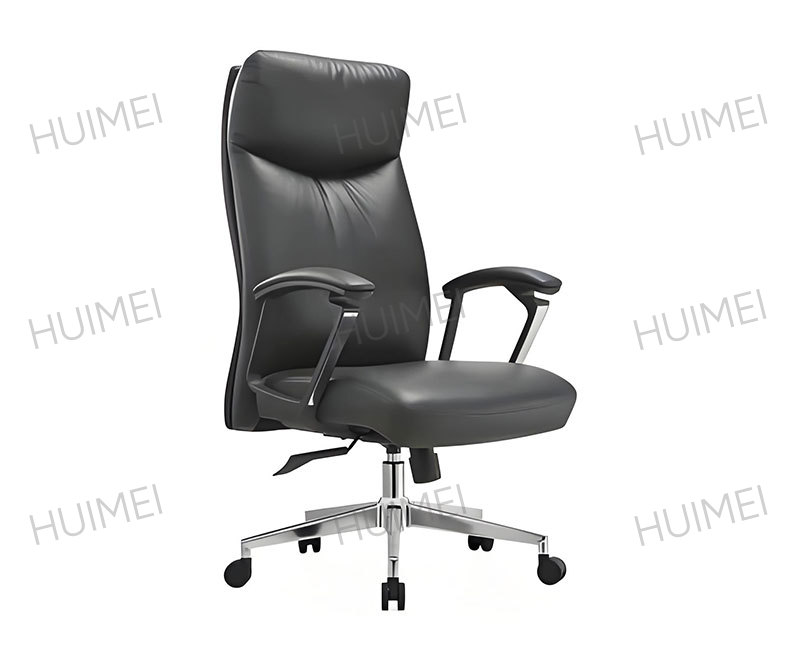 Classroom Chair Boss Chair Office Chair Ergonomic Office Chair Office Rotating Chair with 1. Fabric: Made of high-quality western leather. 2. Sponge: High quality high-density sponge that meets national flame retardant standards. 3. Caster: Guangdong five-s...View Product →
Keep the desk roughly 600 mm from the wall while moving it, and lock the casters before starting work. Both habits prevent the two most common accidents with rolling work surfaces: clipped door frames and desks that drift mid-task.
Planning Mobile Work Surfaces Across a Campus
The same questions appear in institutional buying, only at a larger scale. A school ordering rolling podiums for classrooms, a college equipping a library with movable reading stations, and a training center that needs lecterns shifted between rooms are all specifying the same thing: a light, stable, lockable work surface that survives daily pushing.
Zhejiang Huimei Industry and Trade supplies classroom, dormitory, library, dining and office furniture from a single production base in Wuyi, Zhejiang, and its catalogue treats mobile pieces as part of the campus furniture plan rather than as stand-alone accessories. Steel, wood and paint work are handled in-house, which matters when a school needs a replacement caster, a matching finish, or an additional batch of the same model two years after the first delivery. Buyers who want to review the production lines behind these products can do so before tender documents are finalized.
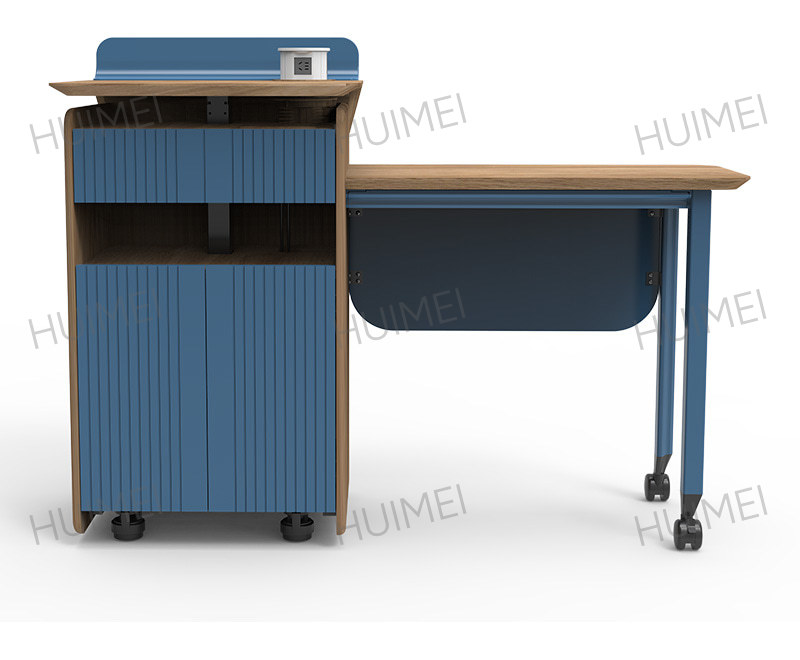 Mobile, Rechargeable, Detachable, And Adjustable Podium with Flexible Movement and Stable W520*D1380*H(1030-1230)View Product →
In teaching spaces, a mobile podium with adjustable height and locking casters covers the lectern role, and a rechargeable version removes the extension cord that usually crosses the front of the room.
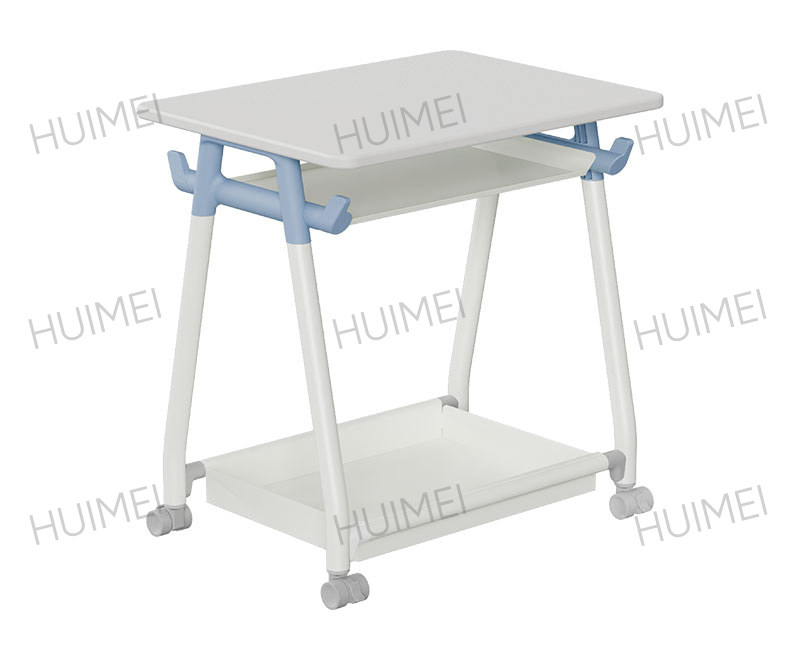 Mobile Small Table/Cart/Storage RackHuimei has the international first-class design level and the technology accumulation of the industry standard setter, and owns the world's leading automated productio...View Product →
A mobile small table and cart serves a similar purpose in libraries and clinics, where the surface doubles as a trolley between shelf sections or between appointments. When these items are ordered together with fixed desks, the height ranges and finishes can be aligned across an entire building instead of being resolved room by room.
Questions Buyers Ask Most
How much weight can a portable standing laptop desk hold?
Small rolling laptop desks usually handle 10 kg to 20 kg, while mobile standing workstations with T or C bases handle 25 kg to 40 kg. Treat moving loads as 30 to 40 percent lower than the static rating.
Do the wheels lock well enough for typing?
Two locked casters hold a laptop setup steady on a level floor. Four brakes are better in corridors, laboratories and rooms with young children.
Can one desk serve both sitting and standing?
Only if the height range spans roughly 650 mm to 1150 mm. Desks that stop at 1000 mm or 1050 mm will not reach a comfortable standing typing height for many adults.
Will a rolling desk fit through a classroom door?
Most models clear a standard 800 mm door, but check the total width including the top, and allow extra clearance for door handles and frames.
A portable standing laptop desk is a simple product with three hard numbers attached: the height range it covers, the load it carries while moving, and the size and quality of its casters. Shortlist by those three, confirm spare parts and warranty before the order, and set the screen and keyboard up properly on the first day. Done that way, a desk on wheels stops being a compromise and becomes the surface people actually work from.
Copyright© Zhejiang Huimei Industry & Trade Co., Ltd. All Rights Reserved.
Professional School Furniture Manufacturer School Furniture Supplier