 English
 русский
 Français
 عربى
 Español
 Português
 简体中文

Outdoor Cafe Tables and Chairs: How to Specify Campus Seating That Lasts
A canteen courtyard, forty tables, one rainy season. That is usually where the difference shows up: not in the catalogue photograph, but in the weld at the leg, the coating under the tabletop edge, and the base plate that starts to rock when a group of students leans on one side.
Outdoor cafe tables and chairs for schools succeed or fail on four decisions: frame material, coating system, base design and top construction. Appearance comes fifth. Get those four right and a set still looks and behaves the same in year five as it did on delivery day. Get them wrong and the replacement budget arrives long before the furniture does.
This guide is written for the people who specify and buy that furniture: campus facility managers, canteen operators, procurement officers and the designers laying out courtyards, terraces, covered walkways and outdoor dining zones.
Content
The Four Decisions That Set the Service Life
The conclusion first: in campus outdoor dining, the frame and the base decide whether a table survives, the coating decides how it looks doing it, and the top decides how often someone has to clean it. Everything else is detail.
Frame
Steel tube in the 1.5 to 2.0 mm wall range gives the most rigidity per unit of cost, which matters when chairs are dragged rather than lifted. Aluminium in 2.0 to 2.5 mm sections is lighter and never shows red rust, but it flexes more, so joint design and wall thickness have to be checked rather than assumed. Hardwood looks warmer in a campus courtyard and can be sanded back, but it needs an oiling routine that schools rarely maintain.
Coating
For metal frames, ask for a multi-stage pretreatment followed by a polyester powder coat of 60 to 90 microns. The pretreatment is the part buyers forget, and it is the part that fails: powder over an improperly degreased tube will lift at the ends within two seasons. Ask for salt spray test data and read which standard and duration it refers to, because a 200-hour result and a 1,000-hour result are not the same claim.
Base
Four legs spread wide will always outperform a slim pedestal on uneven paving. Where a pedestal or cross base is required for looks, insist on a cast or welded plate and adjustable glides, and confirm the fixing method if the table is going onto a terrace above occupied space.
Top
High pressure laminate compact tops at 12 mm resist moisture and wipe down quickly. Slatted timber or aluminium tops shed rain and never hold a puddle. Tempered glass is a poor choice in a school courtyard: it is heavy, it chips at the edge, and when it fails it fails completely.
Frame Materials Compared
The table below is a planning tool, not a warranty. Service life depends on exposure, cleaning chemicals and how often chairs are lifted instead of dragged.
| Frame material | Strengths | Watch points | Planning service life |
|---|---|---|---|
| Powder-coated steel tube | High rigidity, good value, stable under heavy use | Rust starts at cut ends and welds if pretreatment is skipped | 6 to 10 years with recoating |
| Aluminium | Light, no red rust, easier to stack and reposition | More flex, so check joint design and section thickness | 8 to 12 years |
| Hardwood (teak, acacia, eucalyptus) | Warm appearance, repairable, comfortable in heat | Needs oiling twice a year, cracks if neglected | 8 to 15 years |
| Compact laminate top on metal frame | Slim profile, easy to sanitise, no moisture swelling | Edge sealing must be complete; chips are visible | 8 to 12 years |
Sizing and Clearances That Actually Work
Most complaints about outdoor cafe seating are not about quality. They are about fit. A courtyard that holds thirty tables comfortably will feel cramped at thirty-eight, and no amount of good welding fixes that.
- Dining height: 720 to 750 mm tabletop, 430 to 450 mm seat height, leaving 270 to 300 mm between seat and table underside.
- Edge allowance: 600 mm of table edge per person for cafe service, 550 mm as an absolute minimum in a fast-turnover canteen.
- Aisles: 900 mm clear between chair backs for walking, 1,200 mm wherever trays, trolleys or cleaning equipment pass.
- Wheelchair access: at least 900 mm clear width, 700 mm knee clearance under the top and 500 mm of depth.
- Bar height: 1,050 to 1,100 mm tables pair with 750 mm stools and suit standing terraces rather than full meals.
- Chair-to-chair spacing: 750 mm back to back when both seats are occupied.
One extra check for outdoor layouts: door swing and drainage. Tables placed where rainwater channels across the paving will sit in standing water after every storm, which shortens the life of any finish regardless of specification.
Wind, Weight and Storage
An exposed courtyard and a sheltered loggia are two different specifications. Wind load acts on the top like a sail, and a light table with an umbrella is the first thing to go over. Practical rules that work in tender documents:
- Free-standing dining tables should weigh 20 kg or more, or be anchorable, wherever the site is open to wind.
- Umbrella bases should be 25 to 40 kg, filled or cast, and never rely on the tabletop for stability.
- Stackable chairs should stack four to six high with protective glides, and the stack height should fit the store cupboard the campus actually has.
- Nesting tables save more floor area than folding tables and survive handling better, because no hinge is involved.
Ask for the packed volume per set as well as the weight. Storage space is often the hidden constraint that decides whether an outdoor set is used for eight months a year or put away and forgotten.
Cleaning, Repairs and Spare Parts
Outdoor dining furniture in a school is cleaned more often than it is inspected. Specify surfaces that tolerate pressure washing, and check that the coating supplier approves the cleaning chemicals the site uses, since aggressive degreasers will dull a powder coat within a term.
Two procurement habits pay for themselves. First, order around five percent spare chairs with the original batch, so colour and profile match when replacements are needed. Second, confirm that glides, feet, fixings and touch-up paint are available as separate items for at least five years after delivery. Stainless steel fixings are worth the small premium outdoors, because standard zinc-plated bolts become the weak point at every joint.
A Procurement Checklist
- Define the exposure: fully open, partially covered or sheltered, and note wind direction and drainage on the plan.
- State frame material and wall thickness in millimetres, not by adjective.
- State the coating system, pretreatment stages and minimum film thickness.
- Require salt spray test reports and check which standard and duration they reference.
- Set the tabletop construction and edge treatment, and exclude unsealed edges.
- Fix the seating capacity target against the measured paved area, not against the drawing.
- Request a sample set for a full season where possible, or at minimum a physical sample of the finish and a joint section.
- Agree spare parts, warranty terms, colour batch consistency and lead time in writing.
Matching the Furniture to the Campus Layout
Outdoor cafe seating on a school or university site rarely sits alone. It usually extends a canteen, a staff lounge or a covered walkway, which means the outdoor set has to coordinate with whatever is already indoors in colour, tube profile and table height. Buying outdoor pieces as an afterthought to an indoor dining order is how mismatched courtyards happen.
Zhejiang Huimei Industry & Trade Co., Ltd. builds campus furniture around exactly that logic, with product lines covering teaching, dormitory, library, dining and office spaces. The company describes itself as a one-stop educational equipment manufacturer with in-house steel, wood and coating production, serving education departments, universities and international organisations across more than 100 countries and regions. You can read more about the company and its manufacturing base if you need context for a tender file.
For dining areas specifically, the range includes one-piece canteen dining tables and chairs, which are built for high-traffic, high-cleaning environments:
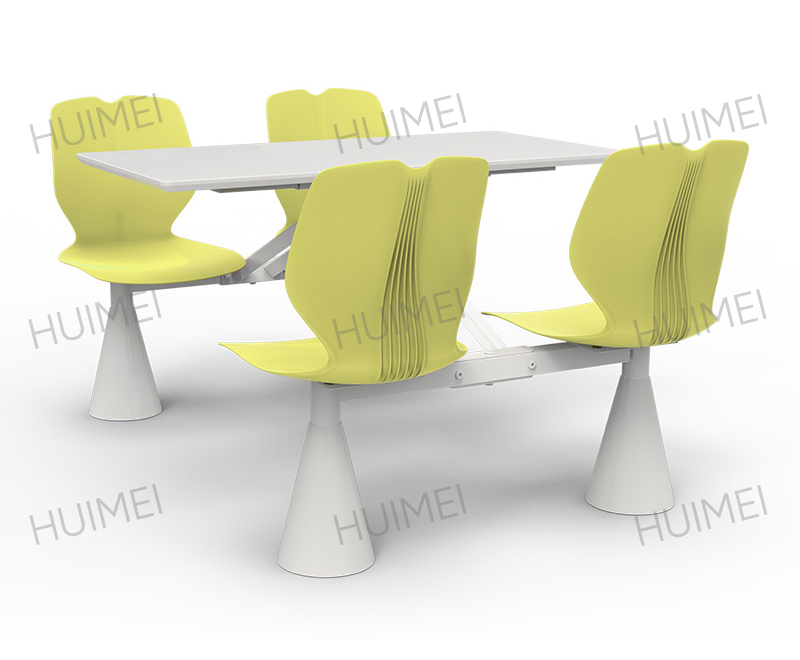 One-Piece Canteen Dining Table and Chair SeriesCompact table-and-seat units for school canteens and high-traffic dining areas, with rounded corners, retractable hooks, and multiple models.View Product →
For an outdoor courtyard, the sensible conversation with any manufacturer starts with three questions: which frame and coating system is rated for permanent outdoor exposure, what fixing method suits the paving, and which spare parts can be supplied two or five years later. A supplier who answers those three specifically is usually a supplier worth shortlisting.
Outdoor cafe tables and chairs are a small line in a campus budget and a large line in the daily experience of the people who use them. Specifying by material thickness, coating system, base design and clearance rather than by photograph takes perhaps one extra meeting, and it is the difference between furniture that is still in service after a decade and furniture that becomes a recurring maintenance item.
Start with the site, write the numbers into the tender, and keep the spares cupboard stocked. The rest is detail.
Copyright© Zhejiang Huimei Industry & Trade Co., Ltd. All Rights Reserved.
Professional School Furniture Manufacturer School Furniture Supplier