 English
 русский
 Français
 عربى
عربى Español
 Português
 简体中文
简体中文
Kidney Tables for Classrooms: A Guide to Sizes, Heights, and Procurement
Three children sit around the curved side of a kidney table while the teacher settles into the shallow indentation. That small piece of furniture shapes how reading groups, math interventions, and one-on-one conferences unfold every day. After reviewing dozens of classroom layouts, procurement documents, and teacher feedback, the conclusion is straightforward: a kidney table works only when its dimensions, height range, and edge design match the students and the room. Getting those details wrong turns a useful teaching tool into a cramped, unstable surface that wastes instructional time. This guide explains what to measure, which trade-offs matter, and how to avoid the most common purchasing mistakes.
Content
- 1 What Exactly Is a Kidney Table and Why It Still Matters
- 2 Sizing and Height Adjustment: The Numbers That Matter
- 3 How Concave Depth Affects Teaching Flow
- 4 Material and Durability Trade-offs
- 5 Comparing Table Shapes for Group Work
- 6 Procurement Checklist and Common Pitfalls
- 7 Working with a School Furniture Manufacturer
What Exactly Is a Kidney Table and Why It Still Matters
A kidney table is a curved desk with a concave cutout on one long side. The shape lets a teacher sit inside the curve while students gather around the outer edge. Unlike a round table, the kidney shape creates a natural focal point for small-group instruction without forcing anyone to twist sideways. Most models appear in early childhood and elementary classrooms, but middle and high schools also use them for intervention groups and language support. The concave depth, measured from the straight edge to the deepest point of the curve, typically ranges from 10 to 18 inches. Too shallow, and the teacher cannot reach materials; too deep, and the table wastes floor space or isolates the teacher from the group.
| Grade Level | Typical Length (inches) | Typical Width (inches) | Recommended Height Range (inches) | Concave Depth (inches) |
|---|---|---|---|---|
| Pre-K to K | 48-60 | 30-36 | 20-22 | 10-12 |
| Grade 1-2 | 54-66 | 30-36 | 21-24 | 12-14 |
| Grade 3-5 | 60-72 | 30-36 | 23-26 | 12-16 |
| Grade 6+ | 66-72 | 30-36 | 26-30 | 14-18 |
Length and width alone do not guarantee comfort. The distance from the concave edge to the far straight edge determines how far a teacher must reach. A 36-inch width works for most adults, but a 30-inch width can feel tight during guided reading. Height adjustment is equally important because a table set for kindergarten becomes unusable for third graders. Many districts now specify adjustable legs with a locking mechanism rather than fixed-height frames.
Sizing and Height Adjustment: The Numbers That Matter
Height mismatches create the most visible problems. When a table sits too low, students slump and the teacher bends forward, which leads to fatigue during a 20-minute group session. When it sits too high, younger children cannot place both feet flat on the floor, and their writing posture collapses. The chart below shows the recommended average height for each grade band. These values assume typical chair seat heights and should be adjusted if your school uses taller or shorter seating.
Recommended Kidney Table Height by Grade Level
The horizontal bars make the progression obvious: a pre-K table averages 21 inches, while a middle school table reaches 28 inches. That seven-inch difference is not trivial, because a fixed-height table cannot serve both groups. A school that buys one size for all early grades will end up with uncomfortable students in at least two grade levels. Adjustable legs solve the problem, but only if the adjustment range covers the full span. Look for a range of at least 20 to 30 inches if you want one table model to serve multiple grade bands. For schools that need to standardize height adjustment across standard desks and kidney tables, manufacturers like Huimei offer adjustable steel-wood desk and chair sets that share the same adjustment mechanism.
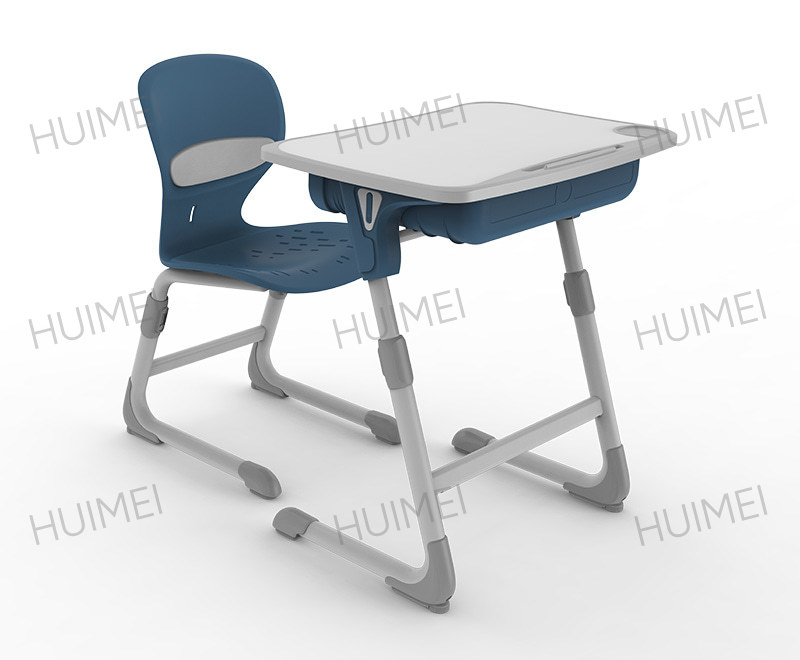 Height Adjustable Steel-Wood Desk and Chair Set for Primary and Secondary SchoolsWith a 640–790 mm desk range and separate primary and secondary chair heights, this steel-wood set supports multi-grade classroom standardization; features include ergonomic curved edges, storage slots, and adjustable foot pads.View Product →
How Concave Depth Affects Teaching Flow
Concave depth changes how easily a teacher can move, point, and hand out materials. A shallow curve keeps the teacher close to the students but limits the workspace in front of them. A deeper curve gives more room for a teacher's manual, assessment clipboard, and small group supplies, yet it also increases the distance to the farthest student. The line chart below plots observed teacher movement efficiency against concave depth during small-group reading sessions. Efficiency here means the percentage of time spent on instruction rather than reaching, standing, or repositioning.
Teacher Movement Efficiency vs. Concave Depth
The curve rises sharply from 8 to 12 inches, then flattens, and finally drops after 16 inches. Eight inches of depth forces the teacher to stretch or stand, which reduces instructional time. Twelve to fourteen inches appears to be the sweet spot for most elementary groups. Beyond sixteen inches, the teacher sits farther from the students, and the table begins to feel like a barrier rather than a shared workspace. If your classroom has limited floor space, a 12-inch concave depth usually delivers the best balance between reach and storage. For dedicated intervention rooms with more square footage, a 14-inch depth can accommodate more materials without hurting interaction.
Material and Durability Trade-offs
Kidney tables take a beating. Students lean on them, drag chairs against the edges, and wipe them with disinfectants. The material choice determines how long the surface survives and how much maintenance it needs. Laminate tops are inexpensive and easy to clean, but they can chip at the edges and delaminate after repeated moisture exposure. Solid wood offers a warm look and can be refinished, yet it requires more care and may warp in humid rooms. Steel-wood construction combines a metal frame with a wood or laminate top, which improves stability. Phenolic resin tops sit at the high end: they resist scratches, moisture, and most chemicals, but they cost significantly more. The chart below compares average lifespans observed in school settings.
Average Lifespan by Material
The vertical bars show a clear gap between budget and premium options. Laminate tables average about eight years before edge damage or surface wear becomes noticeable. Solid wood reaches twelve years with proper humidity control, but neglected wood can fail sooner. Steel-wood frames push the average to fifteen years because the metal legs and rails resist wobble and impact. Phenolic resin tops last around eighteen years and often outlive the original classroom assignment. The practical decision is not always to buy the longest-lasting material. For a temporary classroom or a lease space, a laminate table may be the rational choice. For a permanent elementary wing with heavy daily use, the extra cost of steel-wood or phenolic resin usually pays back through lower replacement rates.
Comparing Table Shapes for Group Work
Kidney tables are not the only shape used for small groups. Round tables encourage equal participation, while rectangular tables maximize seating capacity and stack easily. Each shape has strengths and weaknesses that become visible during different activities. The radar chart below compares three common shapes across five practical dimensions: teacher reach, student sight, space efficiency, collaboration, and storage. Higher scores mean better performance in that dimension based on classroom observations and teacher surveys.
Shape Comparison for Group Instruction
The kidney shape scores highest for teacher reach and collaboration because the concave side places the teacher inside the group rather than at the head of the table. Round tables perform better for student sight, since every child can make eye contact with every other child. Rectangular tables win on space efficiency and storage because they align with walls and stack in tight footprints. No single shape dominates all five dimensions, which means the right choice depends on the dominant activity. If guided reading and intervention are the priority, the kidney shape remains the strongest option. If the room hosts many whole-group projects and needs to store tables between sessions, a rectangular table may be more practical. Many schools combine both: kidney tables for small groups and rectangular tables for flexible seating or project work.
Procurement Checklist and Common Pitfalls
Before issuing a purchase order, run through the following points with your team. Each item addresses a failure mode that shows up repeatedly in school furniture audits.
- Verify the height adjustment range. A table that adjusts only from 24 to 30 inches will not serve pre-K or kindergarten students.
- Measure the concave depth against your tallest and shortest teachers. A depth that works for one adult may force another to lean awkwardly.
- Check the edge profile. Rounded or bullnose edges reduce injuries and resist chipping better than square edges.
- Test the leg locking mechanism. Adjustable legs that slip under weight create a wobbly table and a safety risk.
- Confirm the surface can handle your disinfectant protocol. Some laminates degrade when exposed to quaternary ammonium cleaners.
- Ask about replacement parts. Legs, glides, and adjustment knobs should be available years after the initial purchase.
- Consider mobility. Casters make it easy to reconfigure a room, but only if they lock securely and do not damage flooring.
The most expensive mistake is buying a fixed-height kidney table for a multi-grade classroom. The second most expensive is choosing a table that is too wide for the available floor space, which forces teachers to abandon the kidney shape in favor of cheaper rectangular desks. A short trial with one or two tables before a large order can reveal problems that specifications alone do not show.
Working with a School Furniture Manufacturer
Kidney tables are often part of a larger classroom furniture package. Schools that coordinate tables, chairs, storage, and whiteboards through one supplier reduce the risk of mismatched heights and inconsistent materials. Huimei, a one-stop educational equipment manufacturer based in Zhejiang, produces classroom desks and chairs, library furniture, dormitory furniture, and educational office furniture. The company reports serving education departments across more than 20 Chinese provinces and over 180 universities, as well as international organizations such as UNICEF and ICRC. For a kidney table project, ask the manufacturer for detailed height adjustment ranges, edge profiles, and material test reports. You can reach the team through the contact page to discuss custom sizes, finishes, and delivery schedules.
A kidney table is a small purchase compared with a building project, but it shapes daily instruction for years. The right table puts the teacher inside the group, keeps materials within reach, and adapts as students grow. The wrong table creates discomfort, wasted space, and replacement costs. Measure your students, measure your teachers, and measure the room before you order. If you can test one model first, do it. The best kidney table is not the largest or the most expensive one; it is the one that disappears into the background so teaching can take center stage.
Copyright© Zhejiang Huimei Industry & Trade Co., Ltd. All Rights Reserved.
Professional School Furniture Manufacturer School Furniture Supplier