 English
 русский
 Français
 عربى
عربى Español
 Português
 简体中文
简体中文
How to Select Durable University Teaching Desk and Chairs?
Selecting durable university teaching desks and chairs comes down to evaluating five concrete factors before purchase: frame material and wall thickness, joint construction method, surface coating quality, mechanism component grade, and manufacturer testing documentation. Durability is not a vague marketing claim that can be assessed by appearance alone — it is determined by specific, verifiable engineering choices made during manufacturing. A teaching chair that looks identical to a competitor's product on a showroom floor can have a service life three to five times longer or shorter depending entirely on these underlying specifications. This guide provides the practical evaluation framework procurement teams and facilities managers need to select furniture that will genuinely withstand years of intensive university use rather than requiring premature replacement.
Content
- 1 Why Durability Assessment Requires Looking Past the Surface
- 2 Evaluate Frame Material and Wall Thickness First
- 3 Inspect Joint and Weld Construction Quality
- 4 Assess Surface Coating and Finish Durability
- 5 Verify Mechanism and Hardware Component Grade
- 6 Request Testing Documentation and Certifications
- 7 Conduct a Physical Sample Evaluation Before Bulk Purchase
- 8 Consider Total Cost of Ownership, Not Just Purchase Price
- 9 A Practical Selection Checklist
Why Durability Assessment Requires Looking Past the Surface
Furniture showrooms and product photographs cannot reveal the structural decisions that determine long-term durability. Two chairs can appear nearly identical — same upholstery color, similar silhouette, comparable price point — while having dramatically different frame gauge, weld quality, and mechanism components hidden beneath the visible surface.
This matters enormously in university settings because of the scale and intensity of use involved. A single lecture hall teaching station may be used by multiple instructors across 8 to 12 class periods per day in institutions with tightly scheduled room utilization, accumulating wear far faster than furniture in lower-turnover settings such as private offices. Selecting furniture based on durability specifications rather than appearance alone is therefore not an optional refinement — it is the central procurement decision that determines whether an institution replaces furniture every 3 to 5 years or every 10 to 15 years.
Evaluate Frame Material and Wall Thickness First
The frame is the structural foundation of any desk or chair, and its specification has the single greatest impact on long-term durability of any single factor.
Steel Tube Wall Thickness
For steel-framed teaching chairs and desks, wall thickness is the primary determinant of resistance to bending, fatigue, and structural failure under repeated loading. A minimum wall thickness of 1.2 mm is recommended for standard teaching furniture applications, with 1.5 mm or greater preferred at high-stress points such as chair seat frames and desk leg-to-top connections. Furniture using tubing thinner than 1.0 mm is significantly more prone to permanent deformation under the repeated loading cycles typical of daily institutional use.
Request the manufacturer's technical specification sheet and confirm wall thickness explicitly — this figure is rarely visible from external inspection alone and must be obtained from documentation or, where possible, verified with calipers on a sample unit.
Frame Material Selection
Cold-rolled steel is the standard material for institutional furniture frames due to its combination of strength, weldability, and cost-effectiveness. Aluminum alloy frames offer a lighter-weight alternative with excellent corrosion resistance, suited to applications where furniture is frequently repositioned, though typically at a higher cost. Avoid frames constructed primarily from plastic or composite materials in load-bearing structural roles — these materials are appropriate for non-structural components (armrest caps, decorative panels) but lack the fatigue resistance steel provides for primary frame structures subject to years of cyclic loading.
Inspect Joint and Weld Construction Quality
Even high-quality frame material will fail prematurely if the joints connecting frame sections are poorly constructed. Joint failure is one of the most common modes of furniture breakdown in institutional settings, and it is also one of the most difficult defects to identify through casual visual inspection.
Welded vs. Bolted Construction
Fully welded frame joints provide superior long-term structural integrity compared to bolted-only connections, because welds do not loosen under the vibration and cyclic stress that gradually backs out bolted fasteners over years of use. The highest-quality teaching chairs and desks use continuous welds at primary structural joints — seat-to-leg connections, backrest mounting points, and desk frame corners — reserving bolted connections for components that genuinely benefit from disassembly, such as desktop-to-frame attachment for shipping and occasional replacement.
Weld Quality Indicators
When physically inspecting sample furniture, look for these indicators of quality weld work:
- Smooth, consistent weld beads without visible porosity (small holes or pitting), which indicate inadequate shielding gas coverage during welding and create weak points prone to cracking
- No visible undercutting at the weld toe, where the base metal is thinned by an excessively hot or fast weld pass
- Complete penetration at joints, particularly visible from the underside of seat frames where structural loads concentrate
- Absence of spatter or grinding marks that suggest rushed production without adequate quality control
Manufacturers using automated welding processes with consistent process control parameters typically produce more reliable weld quality across an entire production batch than manual welding processes, where quality can vary significantly between individual welders and shifts.
Assess Surface Coating and Finish Durability
The surface finish on metal components protects against corrosion and abrasion damage that, left unaddressed, eventually compromises structural integrity — particularly at weld points and joints where coating coverage is most difficult to achieve consistently.
Powder Coating vs. Liquid Paint
Electrostatic powder coating, cured at temperatures typically between 180 and 220 degrees Celsius, creates a significantly harder and more durable finish than conventional liquid paint. Powder coating bonds more strongly to the underlying metal, resists chipping from impact, and provides substantially better long-term corrosion resistance — all critical factors for furniture subject to the daily contact, cleaning, and incidental impact common in university teaching environments.
When evaluating coating quality, request information on coating thickness (typically specified in microns) and ask whether the manufacturer conducts standard adhesion testing, such as cross-cut tape testing per ASTM D3359, which verifies that the coating will not flake or peel under mechanical stress (Source: ASTM International, D3359 Standard Test Methods for Rating Adhesion by Tape Test).
Desktop Surface Coatings
For wooden or composite desktop surfaces, melamine-faced or high-pressure laminate (HPL) finishes offer strong resistance to scratching, staining, and moderate moisture exposure. Edge banding — the material sealing the exposed edge of a composite panel — should be continuously and securely bonded along its full length; gaps or peeling at edge seams allow moisture penetration that causes the underlying substrate to swell and delaminate over time, a common premature failure mode in lower-quality classroom and lecture furniture.
Verify Mechanism and Hardware Component Grade
Moving mechanisms — chair height adjustment cylinders, tilt mechanisms, casters, and desk height adjustment systems where present — experience the highest cycle counts of any component in teaching furniture and are frequently the first point of functional failure even when the surrounding frame remains structurally sound.
Gas Lift Cylinder Quality
Pneumatic height adjustment cylinders should carry independent safety certification confirming they meet recognized standards for office and institutional seating, such as those established under EN 1335 (European standard for office work chairs) or equivalent regional standards. Quality cylinders are rated for tens of thousands of adjustment cycles, while substandard components can fail or develop slow sinking (where the seat gradually lowers under load over time) within a year or two of regular institutional use.
Caster and Glide Quality
For mobile teaching furniture, caster quality directly affects both durability and floor protection. Dual-wheel casters with sealed bearings roll more smoothly and resist debris accumulation better than single-wheel designs, extending functional life and reducing the floor damage that can result from worn or debris-clogged wheels. For fixed-position furniture, glide quality at floor contact points affects how evenly load is distributed and how well the furniture resists the floor-level wear that eventually loosens leg-to-frame connections.
Fastener Quality
Bolts, screws, and other fasteners used in furniture assembly should be of appropriate grade for the load they carry — Grade 8.8 or higher metric fasteners are standard for structural connections in quality institutional furniture. Self-locking nuts or thread-locking compound at critical connection points prevents the gradual loosening that vibration and repeated use cause over years of operation.
Request Testing Documentation and Certifications
The most reliable way to verify durability claims before committing to a large institutional purchase is to request documented test results rather than relying on manufacturer assurances alone.
Relevant Testing Standards
Several internationally recognized standards address furniture durability testing for institutional and office seating applications, and manufacturers serious about durability typically test against one or more of these:
| Standard | Scope | What It Verifies |
|---|---|---|
| BIFMA X5.1 | General purpose office chairs | Static load, cyclic fatigue, stability testing |
| EN 1335 | European office work chairs | Dimensions, stability, strength, durability |
| ANSI/BIFMA X5.5 | Desk and table products | Load capacity, structural stability, durability |
| ASTM D3359 | Coating adhesion testing | Resistance of finish to flaking and peeling |
| ISO 9001 | Quality management systems | Consistent manufacturing process control |
| Common durability and quality testing standards relevant to institutional teaching furniture procurement | ||
Cyclic Fatigue Testing
Cyclic fatigue testing applies repeated loading to a chair or desk component to simulate years of real-world use within a compressed testing period. For institutional seating, fatigue test protocols commonly apply 100,000 or more loading cycles to backrests, seat surfaces, and mechanism components, verifying that the furniture will not develop structural failure within its intended service life (Source: BIFMA X5.1, American National Standard for Office Chairs — General Purpose Office Chairs, Section 12, Cyclic Fatigue Test Methods).
When evaluating suppliers, ask specifically whether their products have undergone independent third-party testing against a recognized standard, and request copies of test reports rather than accepting general claims of compliance. A manufacturer confident in their product's durability will readily provide this documentation; reluctance to share testing data is itself a meaningful signal worth weighing in the selection process.
Conduct a Physical Sample Evaluation Before Bulk Purchase
Documentation review should always be paired with hands-on evaluation of a physical sample before committing to a large institutional order. Several practical checks can be performed without specialized testing equipment.
- Apply lateral pressure to the frame while seated or with the desk loaded, checking for flex, creak, or movement at joints that would indicate inadequate frame strength or weld quality
- Cycle the height adjustment mechanism repeatedly, feeling for smooth, consistent resistance without binding, grinding, or unexpected resistance changes
- Inspect weld points at the underside of the seat and at major frame junctions for the quality indicators described earlier in this guide
- Examine edge banding and surface seams on desktop and seat panels under good lighting, checking for any visible gaps or inconsistent adhesion
- Test caster rolling resistance on the actual flooring type the institution uses, since caster performance varies meaningfully between carpet, vinyl, and hard flooring surfaces
- Request a sample for a trial period of several weeks in an actual high-use classroom or lecture hall setting, gathering instructor feedback on comfort and any early signs of wear before finalizing a large order
Consider Total Cost of Ownership, Not Just Purchase Price
Durable furniture typically carries a higher upfront unit cost than budget alternatives, but evaluating purchase decisions on total cost of ownership over a realistic service period almost always favors the higher-durability option for institutional buyers.
| Cost Factor | Budget Furniture (3 to 5 year life) | Durable Furniture (10 to 15 year life) |
|---|---|---|
| Replacement frequency over 15 years | 3 to 5 replacement cycles | 1 to 1.5 replacement cycles |
| Procurement administration burden | Repeated tendering and ordering | Minimal repeat procurement |
| Installation and disposal labor | Recurring across each replacement | One-time, infrequent |
| Classroom disruption during replacement | Frequent | Rare |
| Waste and environmental impact | Higher (multiple disposal events) | Lower (single long service period) |
| Illustrative comparison of total cost factors over a 15-year institutional planning horizon | ||
Facilities and procurement teams should calculate an approximate cost-per-year-of-service figure when comparing furniture options, rather than comparing only the initial purchase price. A unit costing more upfront but lasting three times as long as a budget alternative typically delivers substantially lower annualized cost, even before accounting for the additional administrative and labor costs associated with more frequent replacement cycles.
A Practical Selection Checklist
Use the following checklist when evaluating university teaching desk and chair options to ensure durability factors are systematically assessed before purchase:
- Confirm frame wall thickness in the manufacturer's specification sheet — target 1.2 mm minimum for standard applications
- Verify weld construction at primary structural joints rather than bolted-only connections
- Inspect coating type and adhesion testing — favor powder coating with documented cross-cut adhesion results
- Check mechanism certification for gas lift cylinders and confirm cyclic testing data is available
- Request relevant standard compliance documentation, such as BIFMA, EN, or equivalent regional certification
- Physically test a sample unit before committing to bulk order quantities
- Calculate total cost of ownership across a realistic service life rather than comparing only unit purchase price
- Confirm spare parts availability for mechanisms, casters, and other wear components to extend functional life through component replacement rather than full furniture replacement
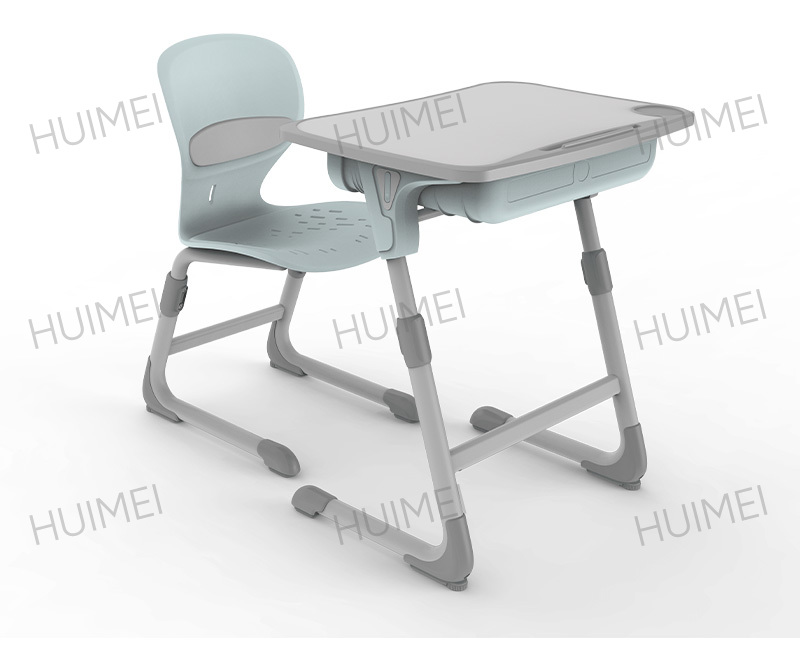
Applying this evaluation framework consistently across procurement decisions allows facilities teams to make durability assessments based on verifiable engineering specifications rather than appearance or price alone. The University Teaching Desk and Chair series from Huimei is engineered with these durability principles built in from the design stage — including robust steel frame construction, quality powder-coat finishing, and mechanism components selected for the cyclic demands of institutional daily use — providing university procurement teams a foundation that meets the specification standards outlined throughout this guide.
Copyright© Zhejiang Huimei Industry & Trade Co., Ltd. All Rights Reserved.
Professional School Furniture Manufacturer School Furniture Supplier