 English
 русский
 Français
 عربى
عربى Español
 Português
 简体中文
简体中文
How to Choose the Best University Teaching Desk and Chair?
The best university teaching desk and chair combination is one that supports prolonged seated study without causing musculoskeletal strain, withstands intensive daily use by hundreds of students over many years, and can be reconfigured to suit different teaching formats — from traditional lectures to collaborative workshops. No single product is right for every classroom; the correct choice depends on the specific room type, the teaching methods used there, the student population's size diversity, and the institution's budget and maintenance capacity.
University students spend an average of 4 to 6 hours per day in classroom seating across their academic schedules. Poor seating ergonomics over this duration contribute directly to back pain, neck strain, reduced concentration, and lower academic performance. A 2019 study published in the journal Ergonomics found that students in ergonomically designed classrooms reported 28% fewer musculoskeletal complaints and demonstrated measurably higher attention levels compared to those in conventionally furnished rooms. The desk and chair are not peripheral infrastructure — they are active components of the learning environment.
This guide covers every factor that matters in the selection process: ergonomic requirements, material durability, room type compatibility, adjustability, safety standards, sustainability, and total cost of ownership — giving procurement officers, facilities managers, and academic administrators a complete framework for making the right decision.
Content
- 1 Understand the Room Type Before Choosing Any Furniture
- 2 Ergonomic Requirements: What the Research Says About Healthy Classroom Seating
- 3 Material Selection: Durability, Maintenance, and Student Safety
- 4 Load Capacity and Structural Safety Standards
- 5 Flexibility and Reconfigurability: Supporting Diverse Teaching Methods
- 6 Technology Integration: Designing for the Connected Classroom
- 7 Accessibility and Inclusive Design
- 8 Sustainability and Environmental Certification
- 9 Total Cost of Ownership: Beyond the Purchase Price
- 10 Key Specifications Comparison by Classroom Type
- 11 Evaluation and Procurement Process: A Step-by-Step Guide
- 12 Common Mistakes to Avoid in University Furniture Procurement
- 13 Final Decision Framework: Matching Furniture to Teaching Environment
Understand the Room Type Before Choosing Any Furniture
University classrooms are not a single category. The teaching desk and chair requirements for a 300-seat tiered lecture theater differ fundamentally from those for a 30-seat seminar room or a flexible active-learning studio. Selecting furniture without first categorizing the room type leads to mismatches that cannot be corrected through ergonomic adjustment alone.
Large Lecture Halls (80–500+ seats)
Tiered or flat-floor lecture halls require fixed or semi-fixed seating with integrated writing tablets or continuous desk surfaces. The priority in this setting is maximizing sight lines to the front of the room, efficient row spacing that allows comfortable passage, and durable upholstery or seat pan materials that survive thousands of use cycles per year without significant wear. Writing surface area is critical — a minimum usable writing surface of 400 mm × 300 mm per student is widely recommended for lecture hall settings where students take handwritten or laptop-based notes.
Standard Classrooms (25–80 seats)
Standard classroom settings benefit most from moveable, stackable, or nestable desk-and-chair sets that allow rapid reconfiguration between lecture rows, horseshoe discussion arrangements, and small-group cluster layouts. Flexibility is the defining requirement here. Furniture that can be reconfigured by students in under two minutes without tools or instructor assistance enables the pedagogical variety that modern teaching methods demand.
Seminar and Tutorial Rooms (10–25 seats)
Small seminar rooms typically use conference-style or boardroom tables with separate chairs. The seating priority is discussion facilitation — chairs that swivel, roll slightly, and allow comfortable turning toward other participants support the conversational dynamics of seminar learning. Armrests become more important in settings where students may sit for extended periods without a separate desk surface to support their forearms.
Active Learning Classrooms (20–60 seats)
Active learning classrooms are purpose-designed for collaborative, student-centered pedagogy. They typically feature height-adjustable tables, mobile chairs, and writable surfaces integrated into the furniture. The furniture must be reconfigurable within seconds, acoustically considered (chair legs that drag noisily across hard floors disrupt the learning environment), and robust enough to handle the frequent movement that active learning formats demand — furniture in active learning rooms may be repositioned 3 to 5 times per class session.
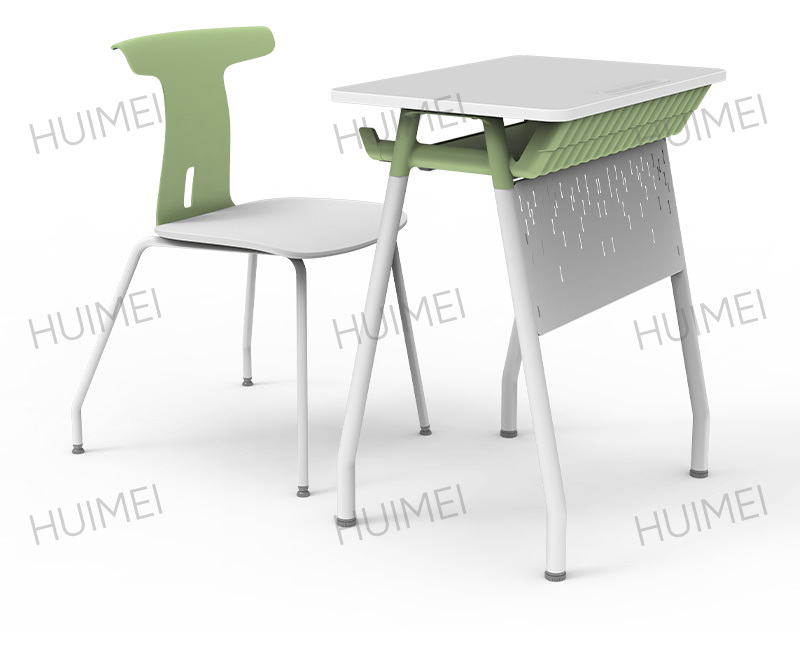
Ergonomic Requirements: What the Research Says About Healthy Classroom Seating
Ergonomics is the single most important functional criterion for university classroom seating because it directly affects both student health and academic performance. The ergonomic requirements for university students differ from general office ergonomics because the student population has a broader range of body dimensions and because classroom tasks — writing, reading, using laptops, participating in discussions — involve different postures than typical office work.
Seat Height: The Foundation of Correct Posture
Correct seat height allows the user to place both feet flat on the floor with the knees at approximately 90 degrees and the thighs roughly horizontal. When seat height is incorrect — too high or too low — the resulting compensatory postures create compressive loads on the lumbar spine and discomfort in the hip flexors and hamstrings within 20 to 30 minutes of sustained sitting.
University student populations span a wide range of body heights. The recommended seat height range to accommodate the 5th to 95th percentile of adult users is 400 mm to 500 mm. Fixed-height chairs set at a single point within this range will be suboptimal for a significant proportion of students — those below the 25th percentile or above the 75th percentile of height. Height-adjustable chairs address this problem but add cost and complexity. A pragmatic middle ground for budget-constrained procurements is to specify two seat height variants within each classroom — standard height (430–450 mm) covering the majority and a higher variant (460–490 mm) for taller users.
Seat Depth and Pan Angle
Seat depth — the front-to-back dimension of the seat pan — should allow users to sit with their back supported by the backrest while leaving approximately 50–100 mm of clearance between the front edge of the seat and the back of the knee. Excessive seat depth forces users to slide forward and lose backrest contact; insufficient depth causes pressure concentration at the thigh. A seat depth of 380–420 mm accommodates the majority of adult users in a university setting.
Seat pan angle — typically 0 to 5 degrees of backward tilt — promotes a natural pelvic tilt that maintains lumbar curvature. Forward-sloping seat pans (negative tilt) are beneficial for writing tasks but should be evaluated carefully as they increase the load on knee joints for users with shorter lower legs.
Backrest Design and Lumbar Support
An effective backrest for classroom seating must support the lumbar curve of the lower back (L1–L5 vertebrae region, approximately 150–250 mm above the seat pan) without forcing the thoracic spine into an unnatural position. Key backrest specifications include:
- Lumbar support height: 170–220 mm above the compressed seat surface, adjustable where budget allows.
- Backrest inclination: 95–105 degrees from the horizontal seat plane for neutral sitting posture.
- Backrest width: Minimum 380 mm to support the full breadth of the user's back.
- Flexibility: A backrest that yields slightly under load — rather than being fully rigid — reduces compressive spinal loading by allowing small postural adjustments throughout the sitting period.
Desk Surface Height and Working Posture
The desk surface height must be compatible with the chair height to allow the user to write or type with the elbows at approximately 90 degrees and the shoulders relaxed. The standard desk height for university classroom furniture is 720–760 mm from the floor — a range that suits most users when combined with a seat height of 430–450 mm. When fixed-height desks are specified, this range represents the best single compromise for the broadest user population.
For active learning classrooms or computer labs, height-adjustable desks with a range of 640–900 mm accommodate both seated and standing working postures — an important consideration as research increasingly supports the health benefits of alternating between seated and standing positions during extended study sessions.
Material Selection: Durability, Maintenance, and Student Safety
University classroom furniture must withstand extraordinarily intensive use. A desk or chair in a heavily scheduled classroom may be occupied for 8 to 12 hours per day, 5 days a week, across a 40-week academic year — equivalent to 1,600–2,400 hours of use annually. Material specification must reflect this intensity.
Desk Surface Materials
The desk working surface must resist scratching, staining from common writing implements and beverages, cleaning chemicals used in institutional maintenance, and the physical impact of books, laptops, and bags being placed on the surface repeatedly.
- High-pressure laminate (HPL): The industry standard for university desk surfaces. HPL panels achieve a Taber abrasion resistance of 150–200 cycles before wear shows (EN 438 standard), resist most common cleaning chemicals, and are available in a wide range of colors and wood-grain finishes. Surface hardness of 3H or higher on the pencil hardness scale is recommended for high-traffic applications.
- MDF or particleboard core with HPL facing: The most common cost-effective construction. The core provides dimensional stability and the HPL facing provides the working surface. Board density of 650–750 kg/m³ is recommended to resist edge chipping and fastener pull-out.
- Solid wood or hardwood plywood: Higher cost, excellent durability, excellent aesthetic — appropriate for seminar rooms and executive education settings where appearance justifies premium investment.
- Compact laminate (self-edge HPL): A solid HPL panel without a separate core, offering superior moisture resistance and edge durability — recommended for environments where desk surfaces are regularly cleaned with wet methods.
Frame and Structural Materials
The desk and chair frame carries all structural loads — the weight of the user, their equipment, and the forces generated by sitting, leaning, and moving. Frame material selection determines both the structural safety and the long-term durability of the furniture.
- Steel tube (powder-coated): The dominant frame material for institutional classroom furniture. Steel sections of 25×25 mm or larger with wall thickness of 1.5–2.0 mm provide excellent stiffness-to-weight ratio. Powder coating in epoxy-polyester formulations provides corrosion resistance and impact resistance superior to liquid paint finishes. Salt spray resistance of 500 hours or more (ISO 9227) is a standard specification for institutional-grade frames.
- Aluminum alloy: Lighter than steel, excellent corrosion resistance without coating, appropriate for stackable or mobile furniture where total unit weight affects handling frequency. Higher material cost partially offset by elimination of corrosion treatment requirements.
- Polypropylene or glass-fiber reinforced polypropylene (GRP): Used for chair shells and seat pans in molded one-piece designs. Glass-fiber reinforced grades achieve flexural strength of 60–90 MPa, sufficient for seating applications where the seat pan and backrest are formed as an integrated shell. UV stabilization is essential for chairs in rooms with significant daylight exposure.
Chair Seat and Backrest Upholstery
Upholstered seating provides superior comfort in seminar settings and executive education environments but requires more maintenance discipline than molded plastic shells.
- Commercial-grade fabric: Minimum 100,000 Martindale rub cycles for institutional application. Stain-resistant treatments (fluorocarbon or silicone finishes) are important in student environments where spills are frequent.
- Vinyl and PU leather: Easier to clean than fabric, more resistant to staining, but less breathable — a consideration in warm climates or rooms without air conditioning where user comfort over extended sessions matters.
- Molded foam density: Seat foam density of 40–50 kg/m³ with ILD (Indentation Load Deflection) of 30–40 lbs balances comfort and durability for institutional seating. Lower density foam compresses permanently with heavy use within 1–2 years; higher density becomes uncomfortably firm.
Load Capacity and Structural Safety Standards
University furniture must meet recognized structural safety standards that define minimum load capacities, stability requirements, and fatigue resistance. These standards are not optional — failure to specify certified furniture exposes institutions to liability and to the risk of furniture failures that injure students.
The most widely applicable international standards for university classroom furniture include:
- EN 1335 (Europe): Office chairs — specifies dimensional requirements, strength, stability, and durability for adult seating.
- EN 15372 (Europe): Non-domestic furniture — strength, durability, and safety requirements for seating used in public spaces including educational institutions. Defines four usage levels (Level 1–4) where Level 4 (very intensive use) is appropriate for university classrooms.
- ANSI/BIFMA X5.1: The American national standard for office seating, defining static load tests, drop tests, fatigue tests, and stability requirements. Specifying ANSI/BIFMA compliance ensures a minimum baseline of structural integrity.
- AS/NZS 4438 (Australia/New Zealand): Height-adjustable swivel chairs — applicable to adjustable seating in teaching and administrative environments.
- GB/T 10357 (China): The Chinese furniture mechanical property testing standard series, applicable to both seating and desk frame structural requirements.
A critical structural specification is static seat load capacity. Institutional chairs should be rated for a minimum static seat load of 150 kg (330 lbs) — not the 100–120 kg ratings common in budget commercial furniture — to accommodate the full range of student body weights and to provide a safe margin against shock loads from students dropping into seats.
Flexibility and Reconfigurability: Supporting Diverse Teaching Methods
Modern university pedagogy emphasizes active learning, collaborative problem-solving, flipped classroom formats, and hybrid teaching — all of which require room layouts that can be changed quickly and reliably. A desk-and-chair set that is difficult or slow to reconfigure actively constrains pedagogical choice and leads instructors to teach in whatever format the furniture most easily accommodates — typically rows facing forward — rather than the format most appropriate for their learning objectives.
Key Flexibility Features to Specify
- Stackability: Chairs that stack 6–10 high on a dolly allow a standard classroom to be completely cleared in under 5 minutes by two people. Specify a maximum stacking height of 1,800 mm for manual handling safety compliance.
- Nesting: Desks designed to nest — with the desk surface sliding under the adjacent desk's frame — can reduce stored footprint by 60–70%, allowing a 30-seat classroom to be cleared to a perimeter layout in under 10 minutes.
- Casters with brakes: Chairs and tables fitted with dual-brake casters (locked for stability during use, unlocked for repositioning) move easily across hard floors without drag noise and remain stationary once positioned without requiring students to hold them.
- Glide caps: For non-wheeled furniture, felt or PTFE glide caps on chair legs allow smooth repositioning on hard floors without scratching the floor surface or generating the scraping noise that disrupts adjacent rooms or concentrating sessions.
- Linkable chairs: Some lecture and classroom chair designs include side connectors that allow chairs to be clipped together in rows for organized theater-style arrangements and separated quickly for group work.
- Tablet arm integration: For seating-only installations (no separate desk), swiveling or folding tablet arms provide individual writing surfaces that retract when not needed, maximizing usable floor space in flexible layouts.
Reconfiguration Time as a Specification Criterion
A practical test during furniture evaluation is to time how quickly a pair of students can reconfigure a set of 30 chairs and desks from a row layout to a cluster layout and back. Target: under 3 minutes for the full reconfiguration cycle. Any furniture set that takes longer than 5 minutes to reconfigure will rarely be reconfigured in practice, effectively eliminating flexible teaching formats from that room regardless of the instructor's pedagogical intentions.
Technology Integration: Designing for the Connected Classroom
Contemporary university students routinely use laptops, tablets, and smartphones as primary learning tools in class. Classroom furniture that does not accommodate these devices — providing neither adequate surface area nor power access — forces students into poor postures as they balance devices on their laps or crane over insufficient writing surfaces.
Desk Surface Area for Technology Use
A standard 15-inch laptop requires a footprint of approximately 360 mm × 250 mm. When a student also needs space for a notebook and writing instrument alongside the laptop, the minimum useful desk surface area becomes 600 mm × 400 mm per student. Lecture hall tablet arms or attached writing surfaces that provide less than this area force compromises between technology use and traditional note-taking.
For computer lab or technology-intensive classroom settings, individual desk widths of 750–900 mm are recommended to accommodate a monitor (if provided), keyboard, and personal belongings simultaneously without crowding.
Power Access Integration
Specifying desks with integrated power and data connectivity eliminates the trailing cables that are a trip hazard in classroom environments and ensures that every student has access to power regardless of seat position. Options include:
- Desk-mounted power modules: Surface-mounted or recessed units providing 2–4 power outlets and USB-A/USB-C charging ports per desk. Requires coordination with the building's electrical infrastructure during installation.
- Underdesk cable management trays: Guide power and data cables from floor boxes to desk surface without exposure. Essential for maintaining a safe, uncluttered classroom environment when full desk electrification is installed.
- Wireless charging surfaces: Emerging option for newer classroom furniture installations, eliminating cable management entirely for compatible devices.
Accessibility and Inclusive Design
University classrooms serve students with a wide range of physical abilities, body dimensions, and access needs. Inclusive furniture specification is both a legal requirement in many jurisdictions and an institutional equity commitment. The standard classroom desk-and-chair specification should be evaluated against the needs of users with disabilities before procurement decisions are finalized.
Wheelchair and Mobility Aid Access
Accessible desk positions for wheelchair users require a desk height of 680–760 mm with knee clearance of at least 670 mm high, 800 mm wide, and 500 mm deep beneath the desk surface. In standard classroom configurations, a minimum of 5% of all seating positions, or at least one position per row, should meet accessible desk specifications. These positions should be distributed throughout the room rather than concentrated at the front or back.
Bariatric Seating
Standard classroom chairs rated for 100–120 kg are inadequate for a portion of the student population. Specifying a proportion of seating rated for 150 kg or higher with a seat width of 500 mm or greater ensures that all students can be safely and comfortably seated. These chairs should be integrated into the room's furniture set aesthetically rather than segregated in a separate area.
Left-Hand Writing Accommodation
Approximately 10% of the student population is left-handed. In rooms where individual tablet arm chairs are specified, left-handed tablet arm versions should be included at the appropriate proportion. For full-size individual desks, left-hand accommodation is automatically provided by the symmetric desk surface, making left-hand specification less critical but still worth confirming with the manufacturer.
Sustainability and Environmental Certification
Sustainability commitments are increasingly central to university procurement policies, and classroom furniture represents a significant material investment that should align with institutional environmental goals. Several dimensions of sustainability are relevant to furniture selection.
Material Sourcing and Recycled Content
- FSC or PEFC certified wood-based panels: Specifying FSC (Forest Stewardship Council) or PEFC (Programme for the Endorsement of Forest Certification) certified MDF and particleboard confirms that the wood fiber originates from responsibly managed forests — a key criterion for institutions with environmental sustainability policies.
- Recycled steel content: Steel frames can contain significant proportions of recycled content (electric arc furnace steel typically contains 80–100% recycled scrap). Request recycled content declarations from suppliers for steel components.
- Recycled plastic content: Molded plastic chair shells can incorporate post-consumer recycled (PCR) polypropylene at 30–50% content without compromising structural performance. This reduces the environmental impact of virgin resin production.
Indoor Air Quality and Chemical Emissions
Wood-based panel products and adhesives used in furniture manufacture can emit formaldehyde and volatile organic compounds (VOCs) that degrade indoor air quality in enclosed classrooms. Specify panels that comply with CARB Phase 2 (California Air Resources Board) or equivalent emissions standards, which limit formaldehyde emissions from MDF and particleboard to 0.11 ppm or less. For markets requiring more stringent performance, E1 (EN 717-1, Europe) or better classification is applicable. GREENGUARD Gold certified products meet both emissions limits and additional requirements for children's environments.
End-of-Life Considerations
University furniture procurement operates on replacement cycles of 10 to 20 years. Specifying furniture that is designed for disassembly — with mechanical fasteners rather than adhesives wherever possible, and with clear material identification on components — facilitates sorting for recycling at end of life rather than landfill disposal. Some manufacturers offer take-back programs for their own products; this should be evaluated as a procurement criterion where available.
Total Cost of Ownership: Beyond the Purchase Price
Purchase price is the most visible cost in a furniture procurement, but it represents only a fraction of the total cost incurred over a furniture set's operational life. A rigorous procurement process evaluates total cost of ownership (TCO) rather than initial unit price.
| Cost Component | Budget Furniture (Low Unit Price) | Institutional-Grade Furniture |
|---|---|---|
| Initial purchase (30 sets) | $3,000–$6,000 | $9,000–$18,000 |
| Expected service life | 4–7 years | 12–20 years |
| Replacement cycles over 15 years | 2–3 replacements | 0–1 replacements |
| Annual maintenance and repair | High (frequent part failures) | Low (replaceable parts available) |
| Total 15-year estimated cost | $9,000–$20,000+ | $9,000–$20,000 |
| Ergonomic performance over life | Degrades (foam compression, frame flex) | Maintained (replaceble components) |
The TCO analysis consistently shows that budget furniture, despite lower initial unit prices, often costs more over a 10–15 year horizon due to the need for earlier and more frequent replacement, higher maintenance costs, and the additional procurement administrative burden of repeated purchasing cycles. Specifying furniture with a demonstrated 15-year service life and available replacement parts typically represents the best institutional value, even when the initial purchase price appears significantly higher than budget alternatives.
Key Specifications Comparison by Classroom Type
The table below consolidates the recommended furniture specifications for each major university classroom category, providing a quick reference for procurement specifications:
| Specification | Lecture Hall | Standard Classroom | Seminar Room | Active Learning |
|---|---|---|---|---|
| Seat height | Fixed 430–450 mm | Fixed or adjustable 430–480 mm | Adjustable 400–500 mm | Adjustable 400–530 mm |
| Desk height | Fixed 720–750 mm | Fixed 720–760 mm | Fixed 730–750 mm | Adjustable 640–900 mm |
| Min. writing surface per student | 400 × 300 mm | 600 × 400 mm | 700 × 450 mm | 700 × 500 mm |
| Chair mobility | Fixed or linked | Stackable / glides | Swivel / casters | Casters with brakes |
| Static load rating | ≥ 150 kg | ≥ 150 kg | ≥ 150 kg | ≥ 150 kg |
| Power access | Row-level power strips | Desk-integrated modules | Table-integrated modules | Table-integrated + floor boxes |
| Reconfigurability | Low / fixed | High | Moderate | Very high |
Evaluation and Procurement Process: A Step-by-Step Guide
A rigorous procurement process protects the institution from making a significant long-term investment in furniture that fails to meet actual needs. The following process is recommended for any university furniture procurement involving more than 20 seats or $10,000 in total value.
- Define room use profiles: Document each room type, primary teaching methods used, class sizes, and any special requirements (accessibility, technology, sustainability targets) before approaching suppliers. A written brief prevents specification drift during supplier negotiations.
- Establish minimum ergonomic standards: Adopt a recognized standard (EN 15372 Level 4, ANSI/BIFMA, or equivalent) as the minimum structural requirement. Require compliance certification from all shortlisted suppliers.
- Request physical samples for user testing: Before committing to a specification, obtain physical samples of shortlisted chairs and desks and conduct a structured user trial with 20–30 students representing the target population. Collect standardized feedback on comfort, adjustability ease, and perceived quality after a minimum 90-minute seated session.
- Test reconfiguration time: With a small group of students, time how quickly a classroom can be reconfigured between a lecture row and a group cluster layout using each shortlisted furniture option. Document results and incorporate as a pass/fail criterion.
- Request TCO information: Ask suppliers to provide expected service life data, available replacement parts and their costs, warranty terms, and references from comparable institutional installations with documented service history.
- Verify sustainability documentation: Request FSC/PEFC certificates for wood-based components, CARB Phase 2 or E1 emissions compliance documentation, recycled content declarations for steel and plastic components, and any third-party environmental product declarations (EPDs).
- Pilot installation before full commitment: For large-scale procurements (100+ seats), install the selected furniture in one room for a full semester before full rollout. Collect maintenance records and user feedback data to validate the specification decision under real operating conditions.
Common Mistakes to Avoid in University Furniture Procurement
Procurement errors in classroom furniture are costly and difficult to reverse once furniture is installed. The following are the most frequently observed mistakes and how to avoid them:
- Specifying by price alone: The lowest-cost option almost never delivers the best TCO in institutional environments. A chair that costs $40 per unit and requires replacement in 4 years costs more than a $120 chair with a 15-year service life and available replacement parts.
- Failing to consult end users: Furniture selected without structured user input often fails to meet actual comfort and usability needs. Include students and instructors in the evaluation process — their feedback identifies practical problems that specification documents alone cannot reveal.
- Ignoring room acoustics: Chair leg materials and floor surface combinations significantly affect room noise levels during reconfiguration. Hard plastic feet on hard tile floors generate significant noise. Test acoustic performance during reconfiguration as part of the evaluation process.
- Under-specifying writing surface area: Desks or tablet arms that are too small for laptop use force students to balance devices awkwardly, creating poor postures and reducing engagement. Do not specify less than 600 × 400 mm of usable surface per student in any classroom where technology use is expected.
- Specifying only one chair height: A single fixed-height chair cannot comfortably accommodate the full range of student body heights. Either specify height-adjustable chairs or provide two height variants per room.
- Neglecting accessibility requirements from the outset: Retrofitting accessible desk positions after a classroom is furnished is expensive and disruptive. Incorporate accessibility specifications — knee clearance, height, and left-hand accommodation — into the initial procurement specification.
- Choosing aesthetics over function: Visually striking furniture that photographs well for marketing materials but proves uncomfortable or impractical in daily use is a common procurement failure mode. Function and ergonomics must take precedence over appearance in every classroom furniture decision.
Final Decision Framework: Matching Furniture to Teaching Environment
The best university teaching desk and chair is the one that correctly serves the specific learning environment where it will be used, the student population that will use it, and the teaching methods it must support — evaluated over its full service life rather than at the point of purchase.
Apply this five-question framework to any classroom furniture decision:
- What teaching methods does this room need to support? If the answer is diverse and active, flexibility and mobility are the primary criteria. If the answer is predominantly lecture delivery, ergonomic quality over extended sessions and durability under high-volume use are primary.
- What is the realistic service life expectation, and what is the total budget over that period? Calculate TCO, not unit price, as the basis for cost comparison between options.
- Does the furniture comply with applicable structural safety and ergonomic standards? If the answer is not confirmed in writing with certification documentation, it should be treated as non-compliant until proven otherwise.
- Have actual students evaluated the comfort and usability of this furniture? If not, conduct a structured user trial before committing to specification.
- Does the furniture meet the institution's sustainability, accessibility, and indoor air quality commitments? Verify with documented certifications, not supplier claims alone.
University classroom furniture is a long-term investment in the conditions of learning. Institutions that approach this investment with the same analytical rigor applied to curriculum design and technology procurement consistently achieve better outcomes — for student comfort, academic performance, operational cost, and institutional reputation — than those that default to lowest-price or aesthetics-first decision making.
Copyright© Zhejiang Huimei Industry & Trade Co., Ltd. All Rights Reserved.
Professional School Furniture Manufacturer School Furniture Supplier