 English
 русский
 Français
 عربى
 Español
 Português
 简体中文

How to Choose the Best Office Chair for Large Men: Fit, Load and Frame
Six feet four, around 270 pounds, and the chair he was issued at work lasted eleven months before the gas lift gave out. The seat had felt fine in the showroom. What he noticed first, months earlier, was not a failure at all: his thighs went numb around the two hour mark, and he had started perching on the front edge of the seat to get relief.
That sequence is typical. Office chairs are proportioned around an average body, so for larger men the problems arrive as a cluster of small mismatches rather than one obvious defect. The seat pan is narrow at the hips. The front edge presses behind the knee. The backrest ends below the shoulder blades. The lift cylinder is rated so close to the user's own weight that it slowly loses pressure.
The answer is not a scaled-up version of a standard chair. It is a chair specified on four numbers first: seat width, seat depth, seat height range together with the armrest range, and a weight rating with genuine headroom. Foam grade, fabric and finish come after those, because no amount of good upholstery fixes a seat pan that is two inches too narrow.
Content
- 1 Fix the four numbers before you discuss upholstery
- 2 A weight rating describes the frame, not the foam
- 3 Seat pan shape and foam density decide comfort at hour three
- 4 Adjustments that carry more weight for bigger users
- 5 Fixed base or casters: match the chair to the room
- 6 What to ask a manufacturer before you place the order
- 7 Faults that surface six months after delivery
Fix the four numbers before you discuss upholstery
Most showrooms open with fabric, colour and stitching. For a user above roughly 100 kg or 185 cm, those are the last decisions. The measurements below decide whether the chair still works at hour six.
| Measurement | Target for a large user | What happens when it is wrong |
|---|---|---|
| Seat width | 20 to 22 in clear between the armrests, with no hard frame edge inside that span | Hips press against the side bolsters and the outer thighs carry load instead of the seat |
| Seat depth | 18 to 21 in, set so there are two to three fingers of clearance behind the knee | The front edge cuts into the back of the thigh and circulation drops on long calls |
| Seat height range | Low end at or below 16 in, high end at or above 21 in | A short range forces either a knees-up posture or dangling feet with pressure under the thighs |
| Weight rating | At least 25 percent above the user's weight, with a Class 4 gas lift | Slow sinking, creaking and structural failures that appear between month eight and month fourteen |
| Backrest height | Top edge at or above the shoulder blades, typically 24 in or more from the seat | Shoulders round forward with nothing to rest against, and upper back fatigue sets in early |
| Armrest span | 10 in or more between pads, adjustable outward as well as up | Shoulders get squeezed inward, which is uncomfortable well before the end of a shift |
None of these dimensions can be corrected later. Tilt tension, lumbar height and armrest angle are all tuneable; an 18 in seat pan stays 18 in. That is why the sizing conversation belongs before the price conversation.
A weight rating describes the frame, not the foam
A published load figure summarises several engineering choices: the thickness of the seat plate, the size of the welds where the legs meet the hub, the diameter of the five star base, and the class of the gas cylinder. General office seating standards in Europe and North America commonly test around 110 to 115 kg for ordinary use. Chairs built for heavier occupants are tested above that and normally show it in a wider base and a stronger column.
In practice the cylinder is the first part to go. A Class 3 lift installed in a chair rated at exactly the user's weight has no margin, and the gradual loss of height that follows is often misread as a soft seat. Ask for a Class 4 cylinder, a base of 27 in or more across, and a stated test load with the report behind it. A five star base in die-cast aluminium resists the twisting that shows up in nylon hubs after a year of daily use.
Seat pan shape and foam density decide comfort at hour three
Width and depth set the outer limits, but the shape of the pan determines where pressure lands. Four details are worth checking on the sample chair rather than the specification sheet.
- A waterfall front edge with a rounded radius of roughly 10 to 15 mm, not a squared-off lip that acts like a bar under the thigh.
- Seat foam in the 45 to 60 kg per cubic metre range. Lower density foam compresses unevenly under a heavier user and develops a slope towards one side within months.
- A flat or gently contoured pan instead of deep side bolsters, which quietly remove an inch or more of usable width.
- Breathable, high-friction upholstery, because a user who slides forward loses the lumbar contact the chair was designed to give.
Check knee clearance at the same time. A seat that sits at the right height for the user still fails if the desk apron or drawer unit leaves less than about 2 in between the thigh and the underside of the work surface.
Adjustments that carry more weight for bigger users
Three adjustments do most of the work once the frame is right. Armrests need to move outward, not only up and down, so the elbows rest at roughly desk height with the shoulders relaxed. A synchro tilt with adjustable tension matters more for a heavier user, because a mechanism tuned for a 70 kg body will feel rigid and encourage the wrong posture. Lumbar support should be height adjustable rather than a fixed bulge, since the curve of the lower back sits at a different point on a longer torso.
Recline range is often overlooked. A backrest that stops at 105 degrees keeps a large user locked upright all day; 115 to 125 degrees with a lockable intermediate position allows the spine to unload between tasks.
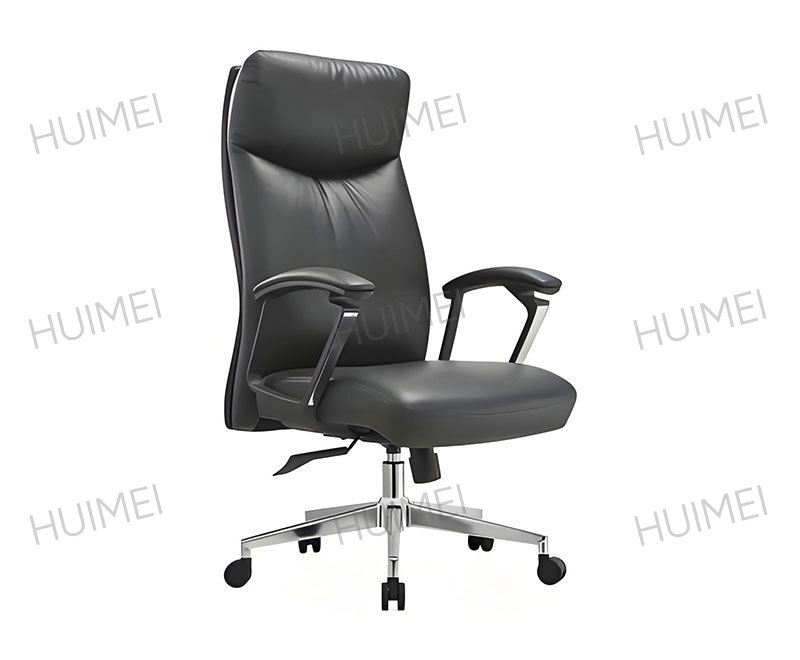 Huimei BG Series Ergonomic Teacher and Office ChairsReview BG-001 to BG-003 for adjustable recline, lumbar support and caster options suited to teacher workstations and long sitting.View Product →
Fixed base or casters: match the chair to the room
In offices, a five star base with casters is the default, and braked casters or a soft-floor wheel set solve most of the sliding complaints that follow. In shared study rooms, lecture halls and training spaces the calculation changes. Casters get kicked, drift during exams and wear faster on hard tile, so a fixed four leg frame with a shaped seat often lasts longer and stays where it is put.
Height adjustment still matters in fixed chairs, particularly where the same room serves users from 160 cm to 195 cm. A lift mechanism with a locking collar gives the range without the maintenance that a gas cylinder eventually demands.
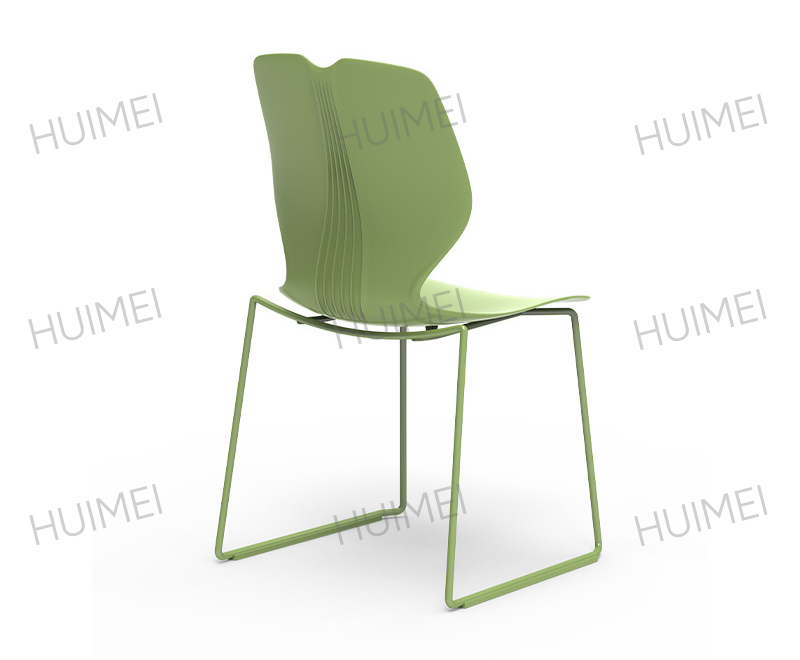 Huimei Apartment Chair Series for Dormitory and Study SeatingCompare fixed, lift and wheeled versions with curved back support for dormitory study, classroom and short-break seating.View Product →
What to ask a manufacturer before you place the order
Specification sheets are written by sales teams, so the useful answers come from production. A supplier that runs its own steel, wood and coating lines can usually state the plate thickness, the cylinder class and the test load without referring the question elsewhere; Zhejiang Huimei publishes its production scope on the technological advantage page, which is a reasonable starting point for a first enquiry. The questions below sort a serious supplier from a trading desk.
- What is the tested load, and which standard was used to test it?
- Which class of gas cylinder is fitted, and is it available in a heavier grade?
- What is the actual clear width between the armrests, measured at the seat surface?
- What is the foam density in the seat, and how much does it lose under a static load test?
- Can the armrests be adjusted laterally, not just vertically?
- Are spare cylinders, casters and armrest pads stocked for the life of the contract?
For a tender covering several hundred chairs, ask for two sample units and put them into the heaviest daily use for a month. Real users find the failure points faster than any bench test.
Faults that surface six months after delivery
The complaints that matter rarely appear in the first week. They arrive after a term or two, and each one points back to a decision made at specification stage.
- Chair slowly sinks during the day: cylinder class too low for the user, or a unit from a batch with inconsistent seals.
- Seat develops a dip on one side: foam density below the working range for the user's weight.
- Wobble at the base: nylon hub or undersized legs, made worse by lateral movement when the user swivels to reach a second screen.
- Armrest pads crack: rigid pads over a narrow metal bar concentrate pressure at the elbow point.
- Fabric shine and slipping: low-friction upholstery combined with a seat set too deep, so the user slides forward all day.
The short version: measure the user, not the average. A chair that clears 20 in between the armrests, allows two to three fingers behind the knee, spans a seat height range that puts the feet flat, and carries a tested load with a quarter more headroom than the person sitting in it will outlast three chairs bought on looks. Buyers sourcing for offices, study rooms and campus buildings can check the wider range of seating and support furniture on the company profile page before shortlisting samples.
Copyright© Zhejiang Huimei Industry & Trade Co., Ltd. All Rights Reserved.
Professional School Furniture Manufacturer School Furniture Supplier