 English
 русский
 Français
 عربى
عربى Español
 Português
 简体中文
简体中文
How to Choose the Best Flip Table and Chair Set for Sleeping?
Choosing the best flip table and chair set for sleeping comes down to five core criteria: correct size for the student's height, ergonomic nap comfort, structural safety, material environmental standards, and durability of the folding mechanism. A set that gets all five right will support both productive study and genuinely restful napping across the full school day — for years of daily use. The most common purchasing mistakes are selecting furniture by price alone or by classroom quantity discounts without verifying that the size matches the students' actual height range, and choosing sets with attractive aesthetics but inadequate nap support cushioning. This guide walks through every selection factor in detail so schools, procurement offices, and parents can make a fully informed decision.
Content
- 1 Step One: Match Furniture Size to Student Height
- 2 Step Two: Evaluate Nap Comfort and Rest Posture Support
- 3 Step Three: Assess the Folding Mechanism Quality
- 4 Step Four: Verify Material Safety and Environmental Standards
- 5 Step Five: Check Structural Safety and Stability
- 6 Comparing Key Flip Nap Desk and Chair Set Types
- 7 Classroom Layout and Space Planning Considerations
- 8 Aesthetic Design: Color and Finish Selection for the Classroom Environment
- 9 Supplier Evaluation and Warranty Verification
- 10 Quick Reference: Flip Nap Desk Selection Checklist
- 11 Summary: The Right Set Balances Ergonomics, Safety, and Durability
Step One: Match Furniture Size to Student Height
Size is the single most important selection criterion for school furniture, and it is the factor most frequently overlooked in bulk institutional purchases. A flip nap desk that is too tall or too short creates musculoskeletal strain during both study and sleep — and because children spend 6 to 8 hours per day at their school desk across the school year, even mild ergonomic mismatches accumulate into significant postural problems over time.
The Standard Size Grading System
School furniture is produced in standardized size grades that correspond to specific student height ranges. The table below shows the recommended desk and seat heights by student height range:
| Size Grade | Student Height | Desk Height | Seat Height | Typical Grade |
|---|---|---|---|---|
| Size 2 | 119–126 cm | 52 cm | 30 cm | Grades 1–2 |
| Size 3 | 127–134 cm | 56 cm | 33 cm | Grades 2–4 |
| Size 4 | 135–142 cm | 60 cm | 36 cm | Grades 4–6 |
| Size 5 | 143–150 cm | 64 cm | 38 cm | Grades 7–8 |
| Size 6 | 151–160 cm | 67 cm | 40 cm | Grades 8–10 |
| Size 7 | 161 cm and above | 71 cm | 43 cm | Grades 10–12 |
Why Height-Adjustable Sets Are the Smarter Long-Term Choice
Children grow 5 to 7 cm per year during primary school years. A fixed-size desk that is correctly proportioned in Grade 3 may be too small by Grade 5. Height-adjustable flip nap desk sets — which offer 4 to 6 discrete height settings for both the desk and seat — can be reconfigured as students grow, extending the useful fit of the furniture across multiple school years without replacement. For institutions purchasing furniture with a planned service life of 8 to 12 years, adjustable models are both ergonomically and economically superior to fixed-size alternatives, even if the initial unit cost is somewhat higher.
Practical Height Check: Verifying Correct Fit
When a student sits in the chair with feet flat on the floor, the correct desk height places the desktop surface approximately 2 to 3 cm above the student's elbow when the arm hangs naturally at the side. The correct seat height places the student's thighs parallel to the floor with knees at a 90-degree angle and feet fully supported by the floor — not dangling. Both checks are quick to perform before purchase using a sample unit and representative students from the intended class group.
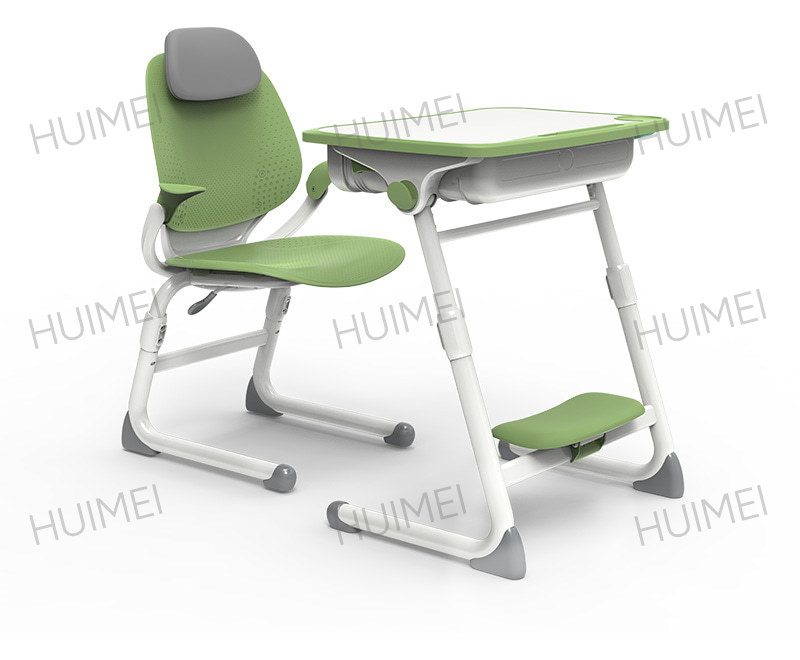
Step Two: Evaluate Nap Comfort and Rest Posture Support
The napping function distinguishes a flip desk and chair set from standard school furniture — and the quality of that napping function varies enormously between models. A set where the nap surface is too small, too hard, or positioned at the wrong angle will not provide genuine rest, defeating the purpose of the midday sleep period entirely.
Nap Surface Size and Dimensions
The resting surface — whether it is a flip-over padded section, a fold-out extension panel, or the main desktop extended with a secondary board — must be large enough to support the student's head and crossed arms without any body part hanging unsupported off the edge. Minimum recommended dimensions for the nap surface are 40 cm wide × 30 cm deep for younger primary students, and 45 cm wide × 35 cm deep or more for secondary students. Surfaces smaller than this force students to hold their arms in a constrained position that causes numbness and discomfort within minutes, making genuine sleep impossible.
Cushioning and Surface Softness
The quality and thickness of cushioning on the nap surface is the most immediately perceptible difference between high-quality and budget flip nap desk sets. Adequate nap cushioning requirements:
- Foam density and thickness: High-resilience foam with a density of 30 to 45 kg/m³ and a minimum compressed thickness of 2 cm after the student's head weight is applied provides comfortable pressure distribution without bottoming out against a hard surface. Very thin or low-density foam compresses fully under the weight of the head and provides no more comfort than the hard desktop surface beneath.
- Removable and washable covers: The cushion cover that the student's face rests on should be removable and machine washable. Children's faces produce oils, sweat, and saliva during sleep; a non-removable cover that cannot be laundered becomes hygienically problematic within weeks of use.
- Breathable fabric: A breathable cotton, bamboo fiber, or moisture-wicking fabric cover prevents heat buildup and facial sweating during the nap period — an important comfort factor in classrooms without air conditioning during warm months.
Nap Surface Angle and Neck Position
When a student rests their head sideways on the desk surface, the angle between the desk surface and the horizontal determines the degree of neck flexion. A perfectly flat horizontal surface forces the neck into maximum lateral flexion — an uncomfortable position that causes neck and shoulder pain during extended rest. A slight forward tilt of the nap surface (approximately 5 to 10 degrees downward at the front edge) reduces this neck flexion significantly, producing a more comfortable and physiologically neutral resting head position. Look for flip nap desk designs that incorporate this forward tilt into the nap surface, either through the natural position of the fold-down extension or through an adjustable tilt mechanism.
Chair Rest Comfort: Reclining vs. Forward-Lean Designs
The two main chair design approaches — forward-lean (student rests on the desk) and reclining (student leans back in the chair) — offer different comfort profiles:
- Forward-lean designs are more common and space-efficient. The student folds their arms on the desk nap surface and rests their head on them. Comfort depends heavily on nap surface quality (cushioning, size, angle) and chair seat height relative to desk. Well-designed forward-lean sets are comfortable and familiar to students.
- Reclining chair designs produce a more physiologically natural rest posture — closer to lying down — but require more depth space behind each desk row and a chair backrest rated to hold the student's full body weight in a reclined position. They are typically found in higher-specification classroom furniture sets and are particularly well-suited to older students who benefit more from a more horizontal rest angle.
Step Three: Assess the Folding Mechanism Quality
The folding or flipping mechanism is the defining engineering feature of a nap desk set — and it is also the component most likely to fail first if quality is compromised. A mechanism that jams, requires adult assistance, slams unexpectedly, or develops looseness after a few months of use will undermine the entire daily nap routine and create safety risks.
Child-Operated Ease of Use
The nap desk transition must be operable by the student independently, without teacher assistance, using no more force than a child of the relevant age group can comfortably apply. As a practical benchmark, a primary school student should be able to convert their desk from study to nap configuration in under 30 seconds using one or two hands. Test this directly with sample units and students of the target age before committing to a large purchase.
Anti-Pinch and Anti-Slam Safety Features
Any folding mechanism creates potential pinch points where moving panels come together. High-quality flip nap desk sets incorporate:
- Enclosed hinge design: Hinges are recessed or covered so that no gap large enough to trap a finger exists at any point in the folding arc
- Damped fold-down action: A hydraulic or spring-damping system that slows the fold-down movement, preventing the panel from dropping suddenly under gravity and potentially striking the student's lap or legs
- Positive locking in both positions: A positive mechanical lock in both the study and nap configuration prevents the desk from transitioning unintentionally — for example, a student accidentally knocking the desk into nap mode mid-lesson, or the nap surface folding back while the student is resting on it
Long-Term Mechanism Durability
A flip nap desk used by a full class of students over a school year will have its mechanism operated approximately 200 times per set per year (once each way, approximately 200 school days). Over a 10-year service life, this totals around 2,000 full fold-unfold cycles per set. Ask suppliers for their mechanism's rated cycle life — quality mechanisms are typically rated for 5,000 cycles or more. Mechanisms with metal-on-metal hinge components and sealed bearings substantially outlast those with plastic hinge components or exposed sliding surfaces that accumulate wear particles and develop play over time.
Step Four: Verify Material Safety and Environmental Standards
Because students rest their faces directly on the nap desk surface, the material safety requirements for flip nap desk sets are even more stringent than for standard school furniture. Prolonged close contact with the face — through a 20 to 40 minute rest period, repeated daily — means that any harmful substance present in the surface material has a sustained opportunity to be absorbed through skin or inhaled.
Formaldehyde Emission Standards
Wood-based board components — particleboard, MDF — used in the desktop and nap surface must meet rigorous formaldehyde emission limits. The two most commonly referenced standards are:
- E1 standard: Formaldehyde content not exceeding 9 mg per 100 g of dry board (perforator method), or indoor air concentration not exceeding 0.1 mg/m³ — the minimum acceptable standard for classroom furniture
- E0 standard: Formaldehyde content not exceeding 5 mg per 100 g of dry board, or air concentration not exceeding 0.05 mg/m³ — the preferred standard for nap desk sets given that students rest their faces directly on the surface
Always request the formaldehyde test report issued by an accredited third-party laboratory for any flip nap desk set under consideration. Verbal assurances or manufacturer self-declarations without supporting laboratory documentation are insufficient for a purchase involving children's prolonged face contact with furniture surfaces.
Surface Coating and Paint Safety
Powder coatings on metal frame components and surface coatings on desktop panels must comply with limits on heavy metals — particularly lead (Pb), cadmium (Cd), chromium VI (Cr VI), and mercury (Hg). Relevant standards include EN 71-3 (migration of certain elements from toys — applicable to children's furniture by extension) and GB 6675 equivalent national standards. Request heavy metal migration test certificates along with formaldehyde documentation.
Cushion and Foam Chemical Safety
Foam cushions and fabric covers used on nap surfaces should be certified under a recognized textile and foam safety standard such as OEKO-TEX Standard 100 or equivalent, confirming that they are free from:
- Harmful azo dyes that can release carcinogenic aromatic amines on contact with skin
- Phthalate plasticizers that act as endocrine disruptors
- Flame retardant compounds restricted or banned in children's product applications
- Formaldehyde in textile finishes used on the fabric cover surface
Step Five: Check Structural Safety and Stability
School furniture is subjected to dynamic loads from active children that exceed the static loads of normal use — students lean on desks at awkward angles, sit on desk edges, and apply lateral forces that a static load test would not reveal. Structural safety testing verifies that the furniture remains stable and intact under these realistic use conditions.
Key Structural Tests to Verify
- Static load test: The desktop must support a static downward load of at least 500 N (approximately 50 kg equivalent) applied at the center without permanent deformation or structural failure. This simulates the force of a student leaning heavily on the desk with both arms.
- Lateral stability test: The assembled desk and chair set must not tip over when a lateral (horizontal) force of 300 N is applied at the highest point of the furniture. This simulates students pushing against furniture during active classroom movement.
- Nap surface load test: The extended nap surface — whether a fold-out panel or flip-top section — must support a downward load representative of a student's head and upper body weight without deflecting more than a specified limit or causing the mechanism to release unexpectedly.
- Frame joint durability: Repeated load-application tests verify that welded or bolted frame joints maintain their structural integrity through the furniture's rated service life without loosening, cracking, or separating.
Compliance with National and International Standards
Depending on the market, relevant furniture safety standards include GB/T 3976 (China — school furniture for primary and secondary schools), EN 1729 Parts 1 and 2 (Europe — chairs and tables for educational institutions), and ANSI/BIFMA X5.1 (North America — office seating). Request a copy of the third-party test report confirming compliance with the applicable national standard before finalizing any purchase decision.
Comparing Key Flip Nap Desk and Chair Set Types
Different flip nap desk designs suit different age groups, classroom configurations, and budget levels. The comparison below helps narrow the selection based on priorities.
| Design Type | Nap Comfort | Ease of Use | Space Efficiency | Best Age Group | Relative Cost |
|---|---|---|---|---|---|
| Flip-top padded reverse surface | Good | Very easy | Excellent (no extra space) | Grades 1–6 | Moderate |
| Fold-out extension panel | Moderate (hard surface) | Easy | Good | Grades 4–9 | Low |
| Integrated cushion set (desk + seat) | Excellent | Very easy | Excellent | Kindergarten – Grade 4 | Moderate–High |
| Reclining chair with arm cushion | Very good | Moderate | Moderate (needs rear space) | Grades 6–12 | Moderate–High |
| Adjustable tilt-top with full recline | Excellent | Moderate | Moderate | All ages (premium) | High |
Classroom Layout and Space Planning Considerations
Even the best flip nap desk set will underperform if the classroom layout does not accommodate the nap configuration properly. Before purchasing, measure the classroom and plan the desk arrangement to verify that the nap configuration is compatible with the available space.
Aisle Width Requirements
Fire safety and classroom management standards typically require minimum aisle widths of 60 to 90 cm between desk rows. Some flip nap desk designs — particularly fold-out extension panel models — temporarily increase the desk footprint during the nap period, reducing effective aisle width. Measure the desk footprint in nap configuration and verify that required aisle clearances are maintained before selecting this design type for a space-constrained classroom.
Row Depth for Reclining Chair Designs
Reclining chair designs require additional depth space behind each seat row to allow the chair to recline without striking the desk in the row behind. The additional depth required varies by model but is typically 25 to 40 cm more than the standard desk-row spacing. This requirement may reduce the number of rows that can be accommodated in a given classroom compared to forward-lean or flip-top designs that require no additional space in nap mode.
Storage for Personal Items During Nap Time
During the nap period, students' books, stationery, and bags need to be stored away from the desk surface. Prioritize flip nap desk sets that include a wire mesh basket or integrated shelf beneath the desktop to keep items off the floor during rest periods. This prevents trip hazards in the aisles and means students can transition smoothly from study to rest without spending time tidying their desk area.
Aesthetic Design: Color and Finish Selection for the Classroom Environment
The visual environment of a classroom influences both the quality of study focus during lessons and the ease of transitioning to rest during the nap period. Research in educational design consistently shows that light, fresh, low-saturation color palettes in learning spaces support concentration and reduce visual fatigue better than intensely colored or visually busy environments.
- Desktop surface color: Pale wood grain textures — light maple, birch, or natural oak laminate finishes — reduce glare from overhead lighting compared to white or highly reflective surfaces, and create a warm, natural visual quality that is conducive to both concentrated work and relaxed rest. Avoid very dark or very high-gloss desktop surfaces that increase glare and visual fatigue.
- Chair color: Muted, desaturated tones — soft sage green, pale blue, light grey, warm beige — are preferable to saturated primary colors for classroom environments where children spend full school days. Bright saturated chair colors increase visual stimulation and are better suited to break areas and play zones than to focused learning and rest spaces.
- Color consistency across the classroom: A cohesive color palette — all chairs the same color, all desktops the same finish — creates a visually calm classroom environment that is easier to manage and less visually distracting than a mix of colors. Where individual color assignment per student is used (for organizational purposes), limit variation to two or three complementary tones rather than introducing the full spectrum.
- Nap cushion color and visibility: Nap cushions should be a light, easily washable color that shows soiling clearly — prompting timely cleaning — rather than a dark color that conceals accumulation of skin oils and dust. Light grey, pale blue, or off-white breathable fabric covers are practical choices that balance hygiene visibility with a clean classroom aesthetic.
Supplier Evaluation and Warranty Verification
School furniture is a long-term institutional investment. The supplier relationship extends beyond the point of purchase — ongoing availability of replacement parts, responsiveness to warranty claims, and the supplier's continued viability as a business all affect the total value delivered over the furniture's service life.
Minimum Acceptable Warranty Terms
Quality school furniture suppliers offer warranties of 2 to 5 years covering structural defects, mechanism failures, and surface delamination under normal classroom use conditions. Be cautious of suppliers offering only a 1-year warranty on furniture that is expected to serve for 8 to 12 years — a short warranty period often indicates the supplier's own assessment of the product's durability. Confirm specifically that the warranty covers the flip or folding mechanism, as this is the highest-wear component and the one most likely to require service.
Replacement Parts Availability
Over a 10-year service life, some components will need replacement: seat shells crack, cushion covers wear out, and occasionally a hinge mechanism requires servicing. Confirm before purchase that the supplier stocks and can supply the following replacement components:
- Replacement nap cushion covers (washable fabric)
- Seat shells or seat cushions
- Hinge and locking mechanism components
- Floor glides and anti-scratch feet
Requesting Sample Units Before Bulk Purchase
For any procurement of more than 20 sets, always request sample units in the sizes required before placing the full order. Use the sample units in an actual classroom with students of the target age group for a minimum of two weeks — covering both study sessions and daily nap periods. This real-world trial will reveal ergonomic issues, mechanism problems, and comfort shortfalls that are impossible to identify from product specifications or showroom displays alone. The cost of a sample trial is negligible relative to the risk of making an incorrect bulk purchase decision.
Quick Reference: Flip Nap Desk Selection Checklist
Use this checklist when evaluating any flip nap desk and chair set for purchase. Every item should be verified before committing to a bulk order.
- Size match confirmed: Desk and seat heights correspond to the student height range of the intended class group, verified with a physical fit check on representative students
- Height adjustability: Model offers at least 4 discrete height settings, or is fixed at a size correctly matched to the class with no growth span concern
- Nap surface size adequate: Resting surface is at least 40 × 30 cm (primary) or 45 × 35 cm (secondary)
- Cushioning quality verified: Foam density 30–45 kg/m³, minimum 2 cm effective thickness under load; cover is removable and washable
- Mechanism safety features confirmed: Anti-pinch design, damped fold-down, positive locking in both positions
- Child-operated ease tested: Students of target age can convert between study and nap modes independently in under 30 seconds
- Formaldehyde certification: E1 minimum (E0 preferred) confirmed by third-party laboratory test report
- Surface coating and foam chemical safety: Heavy metal compliance and OEKO-TEX or equivalent foam/fabric certification available
- Structural safety standard compliance: Third-party test report confirming compliance with applicable national standard (GB/T 3976, EN 1729, or equivalent)
- Classroom layout compatibility: Nap configuration footprint verified against available aisle widths and row spacing
- Warranty terms acceptable: Minimum 2-year warranty covering mechanism, structure, and surface; replacement parts confirmed available
- Sample trial completed: Units trialed in actual classroom conditions with target age group before bulk order placed
Summary: The Right Set Balances Ergonomics, Safety, and Durability
Choosing the best flip table and chair set for sleeping requires evaluating five interconnected factors — correct size for student height, genuine nap comfort through adequate cushioning and surface dimensions, safe and reliable folding mechanism, certified material environmental safety, and structural durability confirmed by third-party testing. No single factor can be compromised without affecting the others: a perfectly sized set with inadequate cushioning will not provide restful sleep; a comfortable set with an unreliable mechanism will disrupt daily routine and create safety risks; a well-designed set that fails environmental certification is simply not suitable for children's prolonged face contact regardless of how well it performs in other respects. Approach the selection systematically using the checklist above, insist on third-party documentation rather than manufacturer claims alone, and validate the final choice with a classroom trial before committing to a school-wide purchase. The result will be furniture that serves students, teachers, and the institution well for the full decade or more of its intended service life.
Copyright© Zhejiang Huimei Industry & Trade Co., Ltd. All Rights Reserved.
Professional School Furniture Manufacturer School Furniture Supplier