 English
 русский
 Français
 عربى
عربى Español
 Português
 简体中文
简体中文
Choosing Cafeteria Table and Chairs for Schools: A Practical Buying Guide
The lunch bell rings, and within ten minutes the cafeteria is packed. Students weave between narrow rows of tables, some benches are difficult to slide out, and the staff struggles to wipe spills from surfaces that trap crumbs. Every school knows this scene. The choice of cafeteria table and chairs affects how fast students get seated, how much room the cafeteria gains back for other activities, and how long the furniture holds up under daily abuse. Before you sign a purchase order, focus on measurable criteria: structural durability, maintenance requirements, seating capacity per square foot, and the age group of the users.
Content
- 1 Material and Construction: What Determines a Cafeteria Table’s Longevity
- 2 Mobility and Flexible Layouts: Why Folding or Movable Tables Matter
- 3 Seating Capacity and Floor Plan Efficiency: How Many Students per Table?
- 4 Safety Features That Reduce Accidents and Liability
- 5 Why One-Piece Integrated Table and Chair Sets Work
- 6 Budgeting for Long-Term Value
- 7 Final Recommendations for Choosing Cafeteria Table and Chairs
Material and Construction: What Determines a Cafeteria Table’s Longevity
In a school lunchroom, furniture is not treated gently. Trays drop, chairs scrape, and tables take the weight of students who lean too far back. The most reliable cafeteria table and chairs systems use a welded steel frame with a solid, easy-to-wipe top. All-plastic units are light, but they dent and scratch faster than steel. A steel-wood hybrid balances cost and comfort, while a full-steel option with an integrated table top offers the longest service life in demanding environments. The finish is just as important as the frame. A powder-coated steel surface resists chemical cleaners, while a laminate top may peel if moisture gets into the edges. Keep in mind that some disinfectants attack certain plastics, causing the surface to become sticky. The table below compares common material choices found in school cafeterias.
| Material | Expected Service Life | Surface Repair Difficulty | Weight |
|---|---|---|---|
| Steel frame with wood-veneer top | 8-12 years | Moderate; veneer can be refinished | Medium |
| All-steel, powder-coated | 12-15 years or more | Low; scratch-resistant coating | Heavy |
| Plastic/molded polymer | 5-8 years | Difficult; surface cracks cannot be repaired | Light |
Expected Service Life by Material
Expected service life is only one part of the cost story. An all-steel table may cost more upfront, but if it lasts 14 years against 6 years for plastic, the annual cost can be lower. Steel also stands up to cleaning chemicals better than many polymers, which are prone to stress cracking after repeated exposure. The steel-wood hybrid gives a warmer look, which some schools prefer for smaller cafeterias, but the wood veneer needs periodic maintenance. The chart above is based on typical school environments with active cleaning and normal use. If your lunchroom runs three shifts, expect the service life of any material to shift toward the lower end.
Mobility and Flexible Layouts: Why Folding or Movable Tables Matter
School cafeterias rarely serve only lunch. The same room hosts assemblies, exams, parent meetings, and after-school activities. Fixed-in-place tables make those changes difficult. Movable or folding cafeteria tables let staff reconfigure the room in a few minutes. During lunch, movable tables can be rolled into corridors or side rooms to absorb overflow, then stored against a wall to free up space. For schools that need this flexibility, casters, folding joints, and lightweight but rigid frames are critical.
Typical Lunchtime Demand on Seating
The chart shows how demand peaks sharply at noon. If the cafeteria has enough fixed tables for only 100 students, the 12:00 surge forces overflow into hallways or shifts. Movable and folding tables let staff add temporary seating in adjacent areas without disrupting the layout. They can also be wheeled away after lunch to open space for gym or exam use. Schools that pair a fixed row of wall tables with movable center tables typically handle this peak better.
Seating Capacity and Floor Plan Efficiency: How Many Students per Table?
Seating capacity is a balance between density and flexibility. Four-person tables are the easiest to rearrange and can fit in small spaces. Six-person tables are common in school canteens because they work well with fixed class groups. Eight-person tables maximize the number of seats per square meter, but they leave long gaps when only a few students sit down. The most efficient choice depends on how you group students and how long your lunch waves are.
Additional Seats Possible in the Same Floor Area
This comparison uses the same total floor area to show how table size changes seating density. Eight-person tables reduce the amount of floor space lost to table legs and aisles. However, if students arrive in small groups, big tables may sit half-empty, which cancels the density advantage. A school with fixed class groups can use 8-person tables more safely. For open seating, 6-person tables offer the best balance between density and flexibility. Measure the room and count the entrance and exit points before choosing a size.
Safety Features That Reduce Accidents and Liability
Lunchroom accidents are often the result of poor edge design or unstable furniture. Look for rounded edges on tabletops and seat corners so students do not get bruised in crowded traffic. Nonslip feet or locking casters keep tables from sliding when students push in. Folding tables should have pinch-free mechanisms. The table or bench must also resist tipping when a student sits on one corner. These small details reduce both injuries and the liability that follows.
- Rounded edges on all heavy contact points
- Non-slip feet or casters with two-way locks
- Lift-and-push folding mechanisms with hinge covers
- Stable base with a wide footprint that prevents tipping
- Chair or seat height matched to user leg length
For primary schools, lower table heights and a bright edge strip help younger students see the boundaries. High school students are taller and heavier, so the same table model must be checked for load ratings before you order. If your lunchroom serves all grades in the same building, consider adjustable-height tables so the furniture can follow the students as they grow.
Why One-Piece Integrated Table and Chair Sets Work
One-piece cafeteria tables with attached seats solve several problems at once. They hold a fixed distance between chair and table, so students do not have to adjust anything before sitting. The one-piece structure removes the gaps where crumbs, wrappers, and spills collect. Attached seats also cut the noise of chairs scraping on the floor, which improves the dining experience. This design is popular in canteens that rely on quick cleaning between lunch waves, and it is available in both mobile and fixed versions.
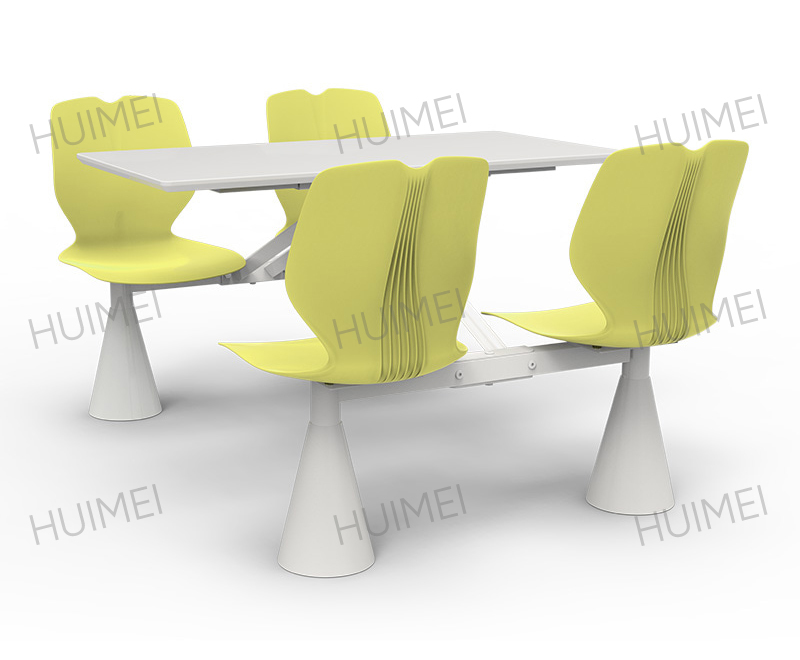 Rotating One-Piece Canteen Dining Table with Attached SeatsThis rotating eight-person table with attached seats simplifies cleaning between lunch waves, saves space with side entry, and adds ergonomic curves plus card slots for practical cafeteria use.View Product →
One-Piece Integrated vs Separate Table and Chair Sets
The radar chart compares five practical criteria, with the outer ring representing the best score. The one-piece design scores higher on cleaning because there are no gaps between table and chair. It also scores higher on space efficiency because students slide in from the side rather than pulling out a separate chair. Safety is slightly better because the attached seat prevents the chair from being unbalanced or pushed under the table. The only area where separate sets often win is the ability to replace a broken chair without changing the whole table, but for most cafeterias the maintenance trade-off is acceptable.
Budgeting for Long-Term Value
A cheap cafeteria table can become an expensive problem within two years. Start with the total cost of ownership, not just the sticker price. Delivery, installation, spare parts, and cleaning time should all be included. Tables that fold or move will add some cost upfront but can save labor later. A safer rule is to choose a welded steel frame and a surface that resists scratches, then budget for periodic replaceable parts such as feet and casters.
- Compare quotes on total delivered and installed cost
- Estimate annual cleaning labor per table design
- Check warranty terms and spare part availability
- Keep a small inventory of screws, seat pads, and caster wheels
Final Recommendations for Choosing Cafeteria Table and Chairs
Start by measuring the cafeteria and drawing the flow path from serving line to seating. Decide whether the room must adapt to different events; if yes, choose mobile or folding tables. Match the table length and seat configuration to your class group size. For high-volume lunchrooms, an integrated table and chair design reduces cleaning time, improves layout efficiency, and maintains safe seating distances. Choose a manufacturer with long experience in school furniture projects, and ask for documentation on materials, load tests, and surface resistance. A company like Zhejiang Huimei, which supplies school dining equipment around the world, can help you match the right table to your building. You can review the company's background under school furniture manufacturer and browse the complete dining table lineup when preparing your final shortlist.
Copyright© Zhejiang Huimei Industry & Trade Co., Ltd. All Rights Reserved.
Professional School Furniture Manufacturer School Furniture Supplier