 English
 русский
 Français
 عربى
 Español
 Português
 简体中文

Children's Library Furniture: Safe, Scaled and Durable Choices for Schools
At a branch library, a four-year-old walks to a picture-book shelf, reaches up, and stops. The book is visible but not reachable. The furniture has already made the decision for her. That small moment explains why children's library furniture should be specified around the child, not around a catalog photo. The best pieces put books within reach, let adults sit at the same level, survive daily contact with shoes, carts, and cleaning, and make supervision easier. Color and theme can come later. Scale, safety, and durability come first.
Content
- 1 Start With the Child's Body, Not the Room's Aesthetic
- 2 Safety Details That Matter More Than Color
- 3 Build Zones Instead of Rows
- 4 Materials and Finishes That Survive a School Year
- 5 A Procurement Checklist for Children's Library Furniture
- 6 Where a Manufacturer Fits in the Process
- 7 Final Practical Note
Start With the Child's Body, Not the Room's Aesthetic
A reading bench that looks charming in a rendering can be unusable if a child's feet dangle or the table edge presses into the chest. Children's library furniture has to fit different ages in the same building. A single seat height will not work for a three-year-old and a ten-year-old. Plan at least three seating zones, or specify adjustable pieces where the budget allows.
| Age band | Seat height | Work surface | Comfortable reach | Planning note |
|---|---|---|---|---|
| 3 to 5 years | 260 to 300 mm | 460 to 520 mm | 900 to 1100 mm | Low picture-book ledges and floor seating |
| 5 to 7 years | 300 to 340 mm | 520 to 580 mm | 1100 to 1200 mm | Short browsing shelves and shared small tables |
| 7 to 9 years | 340 to 380 mm | 580 to 640 mm | 1200 to 1350 mm | Quiet reading and simple research tasks |
| 9 to 12 years | 380 to 430 mm | 640 to 720 mm | 1350 to 1500 mm | Homework, group work, and longer sitting periods |
Use the ranges as a design brief, not as a substitute for a sample. Put a chair and table on site, ask two or three children to sit, and watch what happens. If a child has to climb, slide forward, or hold the book above shoulder height, the setting is already working against the room.
Safety Details That Matter More Than Color
A bright shelf can attract children, but a top-heavy shelf can also attract a climbing child. Safety checks should happen before color approval. The following points are worth writing into the specification, not leaving to a verbal promise.
- Stable base and wall fixing for every shelving run above child height.
- Rounded edges on table tops, shelf fronts, and exposed frames.
- No finger traps, head traps, or gaps that change size when a hinge moves.
- Drawer stops, soft-close hinges, and shelf clips that stay in place under load.
- Low-emission finishes and adhesives, especially in small reading rooms with limited ventilation.
- Non-slip feet on chairs and step stools, plus no exposed bolts at hand level.
Ask for a sample of the edge band, the shelf fixing, and the wall bracket. A furniture set can pass a visual check and still fail in daily use if the bracket is thin, the shelf pin is loose, or the finish marks when a child drags a plastic book bin across it.
Build Zones Instead of Rows
A single row of tables and chairs is a storage solution, not a children's library. Children use a library in bursts. They listen to a story, browse, flop onto a cushion, then settle for homework. The furniture should support those shifts without staff rearranging the room every hour.
For read-aloud and early browsing, use low open shelving, shallow display ledges, and seats that let an adult sit at eye level with a child. A reading chair with a hanging backpack keeps bags off the floor and gives a child a clear place to settle.
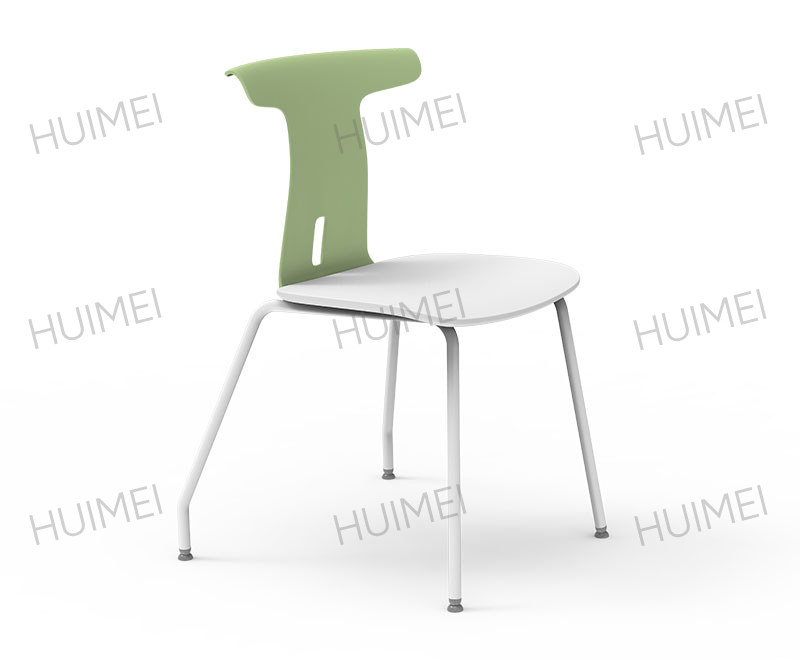 Reading and Library Chair with Hanging BackpackA movable Ming-style chair for reading and study, with a hanging backpack and ergonomic back and seat for longer sitting.View Product →
For independent browsing, face-out shelves matter more than spine-out storage. A child recognizes a cover before a title. A bookcase with a wide base and a low first shelf lets children help themselves without climbing.
For study and shared reading, table geometry matters. A long shared table can serve siblings and small groups, but a deep top makes it hard for a child to reach across. For more detail on table proportions and layout, see this guide to reading tables and shared desks.
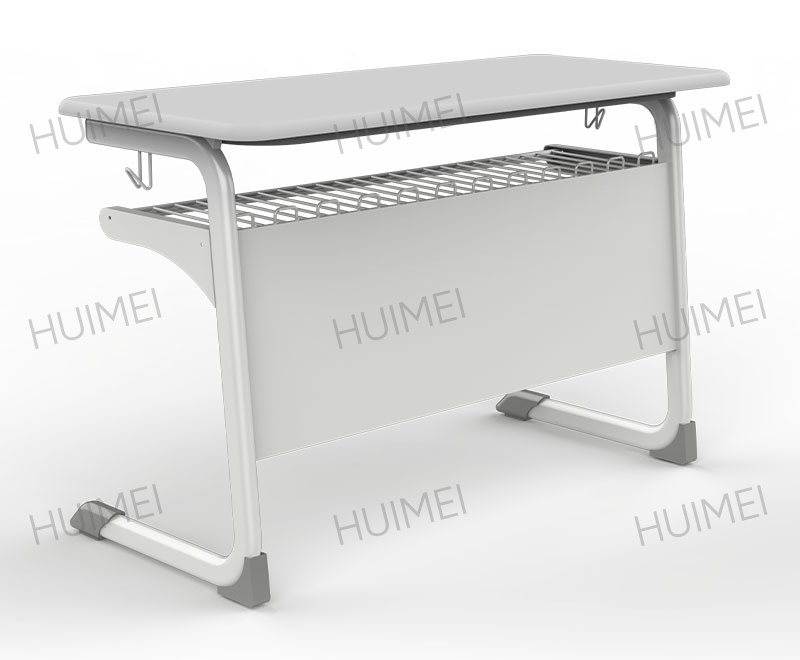 Reading and Self-Study Desks for Library SpacesSingle, double, and shared desk configurations for library and campus study, with durable coated finishes for daily use and cleaning.View Product →
Materials and Finishes That Survive a School Year
Children's library furniture takes more abuse than classroom furniture in one respect. It is used before and after school, during story time, and by siblings waiting for pickup. The finish has to handle shoes, snack spills, craft glue, and daily cleaning.
- Powder-coated steel frames for shelving uprights and chair legs, with touch-up paint supplied.
- 18 mm plywood or moisture-resistant board for shelves that carry picture books and reference sets.
- Edge banding at least 2 mm thick on table tops and shelf fronts, not a thin iron-on strip.
- Laminate or linoleum work surfaces that can be wiped without swelling at the seams.
- Solid wood only where it can be refinished, and only if the maintenance budget supports it.
- Replaceable feet, glides, and shelf pins, because small parts fail before the main structure does.
Ask for a cleaning sample and test it with the products your cleaning team actually uses. A finish that looks good under showroom lighting can turn cloudy after one term of disinfectant wipes.
A Procurement Checklist for Children's Library Furniture
The buying decision usually involves a librarian, a facilities team, and a finance officer. A short checklist keeps the conversation on measurable points.
- Measure the children who will use the room, not only the room itself.
- Set a maximum reach height for the youngest group and mark it on the drawing.
- Require wall-fixing details for every shelf unit above 900 mm.
- Ask for edge, hinge, and finish samples before approval.
- Check that table tops allow two children to sit without knee or elbow conflict.
- Confirm cleaning instructions and spare parts availability.
- Review delivery and installation access, including door widths and lift size.
- Write the warranty, response time, and replacement part process into the order.
Where a Manufacturer Fits in the Process
A manufacturer that already builds school furniture can reduce coordination risk, especially when the library project includes shelving, tables, chairs, and storage in one order. Zhejiang Huimei Industry and Trade Co., Ltd. describes itself as a one-stop educational equipment manufacturer and lists library furniture, bookcases, reading chairs, and reading tables in its range. Its background page notes work with education departments, universities, and international organizations, which is useful context when a project requires batch supply and export documentation. You can review the company background here: company background.
Final Practical Note
Do not buy a themed set as a single decision. Buy the seat that fits the child, the shelf that stays put, the table that allows two children to share a book without colliding, and the finish that still looks presentable after a term of use. If a supplier cannot provide dimensions, fixing details, finish information, and a sample, the price is not the only risk. Children's library furniture works best when it is quiet in the background and reliable in daily use. That is a better goal than making the room look like a picture book for one opening day.
Copyright© Zhejiang Huimei Industry & Trade Co., Ltd. All Rights Reserved.
Professional School Furniture Manufacturer School Furniture Supplier