 English
 русский
 Français
 عربى
 Español
 Português
 简体中文

Adjustable Height Classroom Tables: A Practical Buyer Guide for Schools
A middle school in Zhejiang replaced 600 classroom desks two years after purchase. Nothing had broken. The shortest students in each class could not put their feet flat on the floor, and the tallest had to slouch to write. The furniture was fine; the specification was wrong. That is the failure mode adjustable height classroom tables exist to prevent, and it only works when the height range, the adjustment mechanism and the frame stability are written into the purchase order as numbers.
The conclusion first. Buy a table whose height range covers your shortest and tallest students in the same room, choose the adjustment mechanism based on who will actually operate it, and treat wobble, dimensional tolerance and edge finishing as test items rather than as sales claims. The rest of this article explains why each of those three decisions decides whether the furniture serves ten years or becomes a maintenance list.
Content
- 1 Why One Fixed Height Cannot Serve One Classroom
- 2 Choosing the Height Range That Fits Your Students
- 3 Adjustment Mechanisms Compared
- 4 Tolerances and Stability: The Details That Generate Complaints
- 5 Matching Tables to Chairs and to the Room
- 6 A Procurement Checklist for Adjustable Height Tables
- 7 How to Read a Supplier Response
- 8 The Bottom Line
Why One Fixed Height Cannot Serve One Classroom
In a mixed-ability class of eleven-year-olds, standing height commonly spans 1330 mm to 1570 mm. The ergonomically correct table height for the shortest student in that group is around 580 mm, while the tallest needs closer to 650 mm. A fixed desk cannot serve both, and students compensate in ways teachers notice before anyone measures anything: slouching, sitting on one foot, leaning on an elbow, or sliding forward until the chair back no longer supports them.
Adjustability also simplifies procurement. One SKU covering three grade bands replaces three fixed-height products, which cuts warehouse space, spare-part variety and the awkward mid-year problem of moving furniture between rooms after a class is regrouped.
What adjustability does not fix
Height is one variable among several. Work surface depth, the seat-to-table differential and the aisle width between rows affect posture just as much. A 1200 mm double desk with a shallow top will still crowd a student using a textbook and a tablet together, and adjustable legs cannot rescue a room that is 400 mm too narrow for the class size it holds.
Choosing the Height Range That Fits Your Students
Most tender documents ask for a range such as 550 to 760 mm and stop there. The more useful questions are what range your actual student population needs and how many settings sit inside it.
| Grade band | Typical student height | Recommended table height | Recommended seat height |
|---|---|---|---|
| Early years, ages 5 to 7 | 1100 to 1300 mm | 460 to 530 mm | 260 to 300 mm |
| Lower primary, ages 7 to 9 | 1200 to 1420 mm | 530 to 590 mm | 300 to 340 mm |
| Upper primary, ages 9 to 11 | 1330 to 1570 mm | 580 to 640 mm | 340 to 380 mm |
| Lower secondary, ages 11 to 14 | 1450 to 1700 mm | 640 to 700 mm | 380 to 420 mm |
| Upper secondary and adult | 1600 to 1900 mm | 700 to 760 mm | 420 to 460 mm |
Two practical notes. First, the difference between table height and seat height should stay between about 250 mm and 300 mm. Outside that band, students either raise their shoulders or slump forward. Second, overlap between bands matters more than total range. A 100 mm range in 20 mm steps serves daily classroom use better than a 200 mm range in 50 mm steps, because fine steps let a teacher correct one or two students without dismantling a whole row.
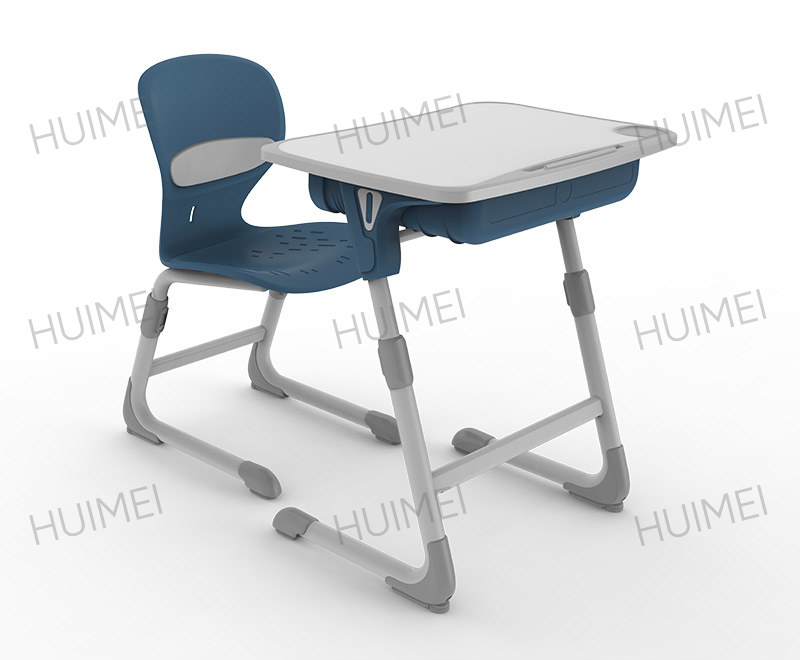 Height Adjustable Steel Wood Desk and Chair SetA height-adjustable steel-wood desk and chair set for primary and junior high classrooms, with ergonomic desk and chair features for varied student sizes.View Product →
For primary and junior high classrooms, a height adjustable steel wood desk and chair set with a locking pin system covers the 530 to 700 mm band in 20 to 30 mm steps, which is the range most schools actually use across six or seven grades.
Adjustment Mechanisms Compared
The mechanism decides who can change the height and how often. A school that assumes teachers will reset desks weekly will be disappointed by a bolt that needs a spanner.
| Mechanism | Typical range | Increment | Usual operator | Trade-offs |
|---|---|---|---|---|
| Pin and hole detent | 100 to 200 mm | 20 to 30 mm steps | Staff, term by term | Lowest cost and fewest parts, but coarse steps |
| Threaded bolt with tool | 150 to 250 mm | Continuous | Maintenance staff | Cheap and secure, slow to change, tools get lost |
| Hand crank or gear | 150 to 300 mm | Continuous | Teacher or student | No lifting required, higher part count |
| Gas lift or pneumatic | 100 to 200 mm | Continuous | User | Fast and smooth, more seals to service over time |
For most K to 12 classrooms, a pin and hole system with clearly marked positions is the practical choice. It is robust, difficult to tamper with, and a caretaker can reset an entire classroom in under an hour at the start of a term. Crank systems earn their extra cost in shared rooms where the same table is used by different year groups on the same day.
Tolerances and Stability: The Details That Generate Complaints
Wobble reaches the head teacher before any specification does. A table that rocks 3 mm at the corner feels unsafe even when it passes a static load test, and the cause is usually leg length variation, thin tube walls or missing cross bracing rather than the adjustment mechanism.
Put these items into the specification as measurable requirements:
- Table top flatness within 1 mm across 600 mm of surface.
- Leg length matching within 2 mm across all four legs.
- Frame tube wall thickness stated in millimetres, not described as sturdy.
- Static load rating of at least 80 kg on the table top and 100 kg on the seat.
- A positive lock at every height setting, never friction alone.
- Exposed edges with a minimum 2 mm radius and no open pinch points around the adjustment channel.
- Powder coating of 60 to 80 microns that tolerates mild soap cleaning and humid coastal air.
Matching Tables to Chairs and to the Room
The seat-to-table differential matters more than the absolute number printed on the frame. Measure the chairs you already own before ordering tables. If seat height is 380 mm, the table top should sit between 630 mm and 680 mm for comfortable writing. If you are buying both, buy them as a set so the pairing is guaranteed rather than hoped for.
Layout math is equally unforgiving. Allow 600 mm of table width per student for writing, 1200 by 600 mm for a double desk, 600 to 900 mm for main aisles, and roughly 1300 mm between rows when chairs must pull out and students must pass behind seated classmates. Rooms that meet the aisle figure on paper often fail it once bags and coat hooks are added.
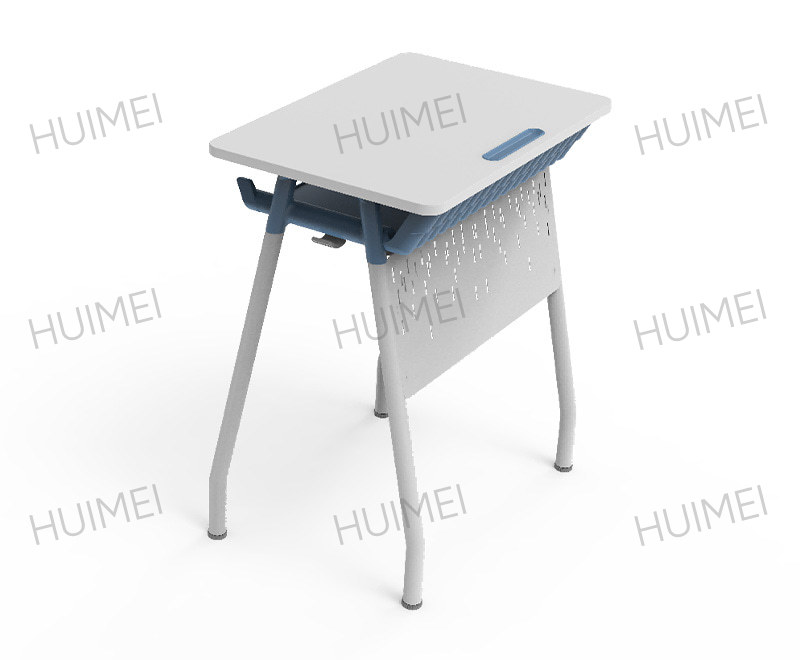 University Teaching Desk and Chair SeriesFor lecture rooms and seminar layouts, this university desk and chair series offers movable, combinable options and adjustable-height designs to fit varied teaching arrangements.View Product →
For lecture rooms and seminar spaces, a university teaching desk and chair series with a defined adjustment band keeps sightlines consistent across the room while still allowing individual correction for taller or shorter students.
A Procurement Checklist for Adjustable Height Tables
- State the required height range in millimetres and the number and size of steps inside it.
- Name the adjustment mechanism and the person who will operate it.
- Require the seat-to-table differential to fall within 250 to 300 mm.
- Ask for static load test results and the test method used to produce them.
- Check tube wall thickness, weld quality and cross bracing on a physical sample.
- Confirm floor leveler travel so uneven tiles and old concrete floors can be handled.
- Ask for the price and lead time of replacement feet, bolts, locking pins and top fixings.
- Confirm whether tables arrive assembled, flat packed or part assembled, and who installs them.
- Verify coating durability and the approved cleaning method in writing.
- Pilot one classroom for a full term before rolling out to the rest of the campus.
How to Read a Supplier Response
Supplier answers are easiest to compare when they are forced into numbers. A manufacturer that can state its tube wall thickness, step increment, load rating and coating thickness on a single page is usually working from a stable production process rather than from a catalogue photograph.
Zhejiang Huimei Industry and Trade Co., Ltd. is a one stop educational equipment manufacturer based in Wuyi County, Zhejiang, with automated lines covering steel parts, wood parts and paint finishing. Its stated customer base includes education departments in more than 20 Chinese provinces, over 180 universities, and organisations such as UNICEF and the ICRC. For a school specifying adjustable furniture, that experience matters in one specific way: height adjustable tables and chairs are built as a paired system rather than as separate items, which is what keeps the seat-to-table differential inside the 250 to 300 mm band.
Some districts now combine height adjustment with other functions. In schools where classrooms double as nap rooms after lunch, a flip table and chair set that converts for lying down removes the need for a second set of furniture in the same room.
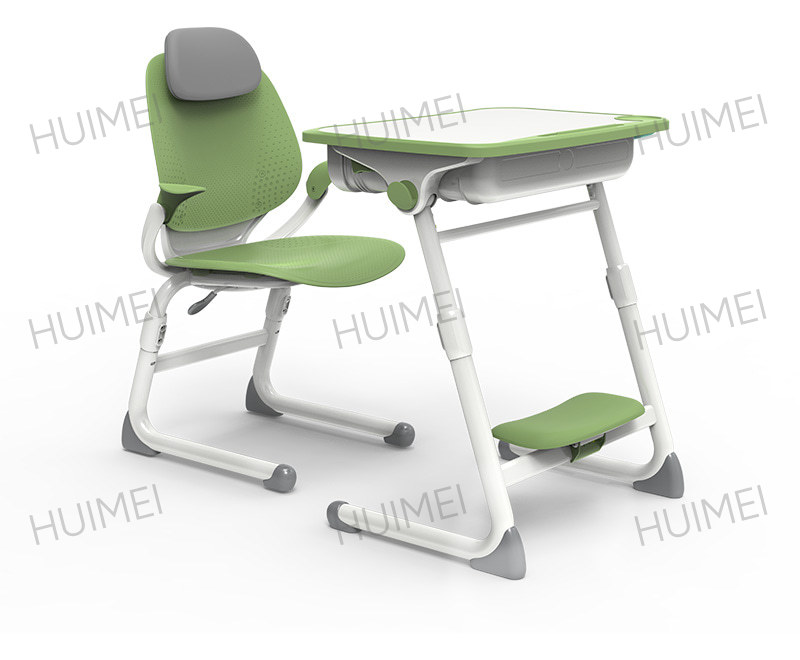 Primary/Middle/High School Flip Table and Chair SetFor classrooms that double as nap rooms, this adjustable flip set switches between learning and lying-down modes without moving desks and chairs.View Product →
Buyers who want the whole span, from early years through university, can browse the classroom desk and chairs category, while the practical comparison in the guide to selecting classroom desks and chairs sets out how the different series compare side by side.
The Bottom Line
Adjustable height classroom tables are a specification exercise, not a style choice. Fix the height range against your real student population, choose a mechanism the people on site can actually use, and put flatness, load and locking requirements into the purchase order as numbers. Do that and the tables will still be in service when the next cohort arrives. Skip it and the replacement order arrives long before the furniture wears out.
Copyright© Zhejiang Huimei Industry & Trade Co., Ltd. All Rights Reserved.
Professional School Furniture Manufacturer School Furniture Supplier