 English
 русский
 Français
 عربى
 Español
 Português
 简体中文

Activity Table With Storage: A Buyer's Guide for Schools and Classrooms
Storage is the part of an activity table that fails first and gets specified last. Tubs crack, drawer runners jam with dried paint, shelf edges swell after a spilled water cup, and a table bought to organise a room ends up pushed against a wall because nothing useful fits inside it.
The practical order of decision is the reverse of the way most quotations are written. Choose the storage first: what has to live inside the table, how far it has to travel, who empties it, and who cleans it. Then size the top, the height, and the frame around those answers.
What follows covers the storage patterns used in classrooms, art rooms, libraries, and after-school spaces, the dimensions that decide whether a seated child can reach the storage, and the checks worth running before a purchase order is signed.
Content
- 1 What an activity table with storage is expected to hold
- 2 Storage configurations and where each one fits
- 3 Dimensions and tolerances worth writing into the order
- 4 Matching the table to the room, not to the catalogue
- 5 Safety, durability, and cleaning checks
- 6 What to put in the specification
- 7 Questions buyers ask most often
What an activity table with storage is expected to hold
In an art room the storage holds paint pots, brushes, water cups, trays of drying work, and scrap paper. In a STEM or maker space it holds kits, small tools, fasteners, and half-built models. In an early years room it holds blocks, sand toys, and picture books. In an after-school room it holds whatever the programme is using that week, which changes more often than any catalogue predicts.
A table with storage works when three conditions hold at the same time. The contents fit inside the container without stacking above the rim. A seated child can reach the container without standing up or crawling under the top. And an adult can empty, wipe, or replace that container in under a minute, because that is the amount of time a cleaner or a teacher will realistically give it.
Open containers are emptied more often than closed ones in rooms used by children under eight. That is not a stylistic preference. It is what happens when hidden storage fills with objects nobody claims. Closed drawers suit tools, spare parts, and teacher materials; open tubs suit the materials children are expected to fetch themselves.
One further expectation is easy to miss. Storage under a table reduces the space left for legs. If a design trades knee room for capacity, children sit sideways, chairs get pushed out of the way, and the table stops working as a work surface. Capacity and seating comfort have to be specified together, not one after the other.
Storage configurations and where each one fits
Five patterns cover most of what appears on a school order form.
| Storage type | What it holds | Fits best | Main risk |
|---|---|---|---|
| Tubs or bins under the top | Paint pots, blocks, small trays | Early years and art rooms | Cracked tubs, lids that go missing |
| Full width lower shelf | Paper stacks, board games, larger trays | Craft and after-school rooms | No containment, items slide out |
| Drawer pedestal | Tools, small parts, teacher materials | STEM and maker spaces | Runner wear, weight limits |
| Cubby or open compartment unit | Books, kits, personal items | Reading corners and libraries | Dust, poor visibility of contents |
| Mobile table with storage rack | Mixed loads moved between rooms | Shared rooms, multipurpose halls | Casters and brakes, weight distribution |
A mobile version of the same idea earns its keep wherever one table has to serve two rooms. A table on braked casters with a storage rack underneath lets a teacher move the surface and the materials together, instead of carrying trays down a corridor twice a day.
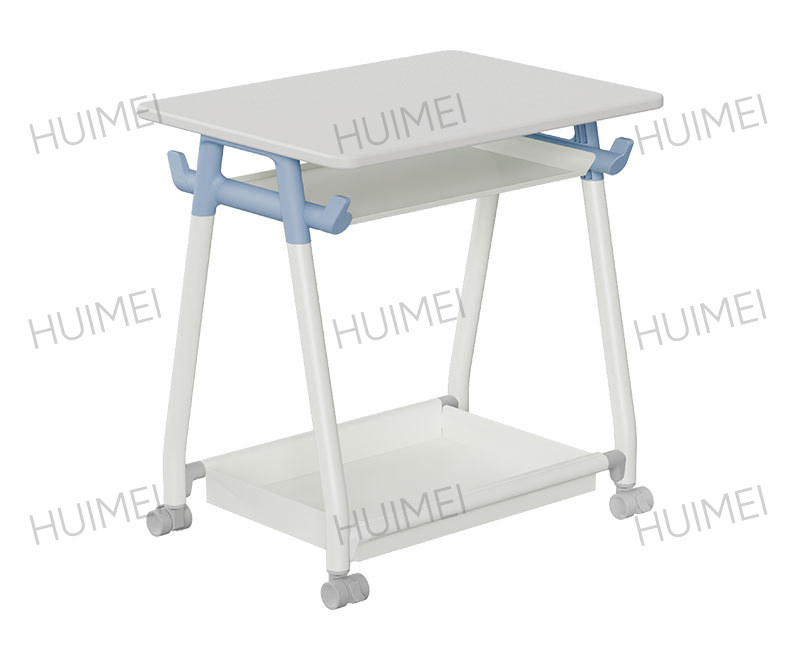 Huimei Mobile Small Table, Cart, and Storage RackFor classrooms needing one table to serve two rooms, this movable cart and storage rack combines surface, transport, and organization.View Product →
The trade-off is weight. Every kilogram in the storage also has to be pushed, steered, and stopped. Keep loaded mobile tables under roughly 100 kg, match wheel diameter to the floor, and insist on brakes that hold when a child leans on the edge of the top.
Dimensions and tolerances worth writing into the order
Quotations often describe storage as simply under-table storage. Ask for numbers instead. These are the figures that decide whether the table works in a real room.
- Tabletop height: 22 to 24 inches for early years, 26 to 27 inches for lower primary, 29 to 30 inches for upper primary and adult users.
- Knee clearance: at least 24 inches of width and 20 inches of height free of storage, so the table remains a table and not a cabinet with a lid.
- Container depth: 4 to 6 inches internally covers most art and craft supplies. Deeper containers hide contents and collect debris at the bottom.
- Top thickness: 18 to 25 mm for laminate faced board, with 1.2 to 1.5 mm PVC edge banding on every exposed edge.
- Casters: 75 mm wheels for carpet, 50 mm for hard floors, with locking brakes on at least two wheels.
- Working load: assume 40 to 60 kg distributed on the top and 15 to 25 kg inside the storage when sizing frames and joints.
- Level tolerance: leg height variation within 2 mm across a set, so grouped tables do not rock or show visible gaps.
Two of these deserve extra attention. Knee clearance is the figure buyers regret most often, because it cannot be corrected after delivery. Level tolerance is the one that shows up in photographs, when a group of tables is visibly uneven.
Matching the table to the room, not to the catalogue
Art and craft rooms
Craft work spills. Specify a laminate faced top with sealed edges on all four sides, a full width lower shelf or wide open tubs, and a height that lets an adult work alongside a child. Corner radius matters here more than in any other room.
STEM and maker spaces
Tools and small parts are better off in drawers than in open tubs, which quickly turn into a search exercise. Look for runners rated above the load you expect and a frame that stays rigid when a drawer is pulled fully out.
Reading corners and libraries
Reading zones usually want a longer surface rather than a wider one. A long shared table with a shelf underneath seats four to six children and doubles as a place to leave returned books. School buyers are increasingly treating these surfaces as multi-purpose work areas rather than plain desks, which is why shared reading tables are being specified differently in terms of depth and height.
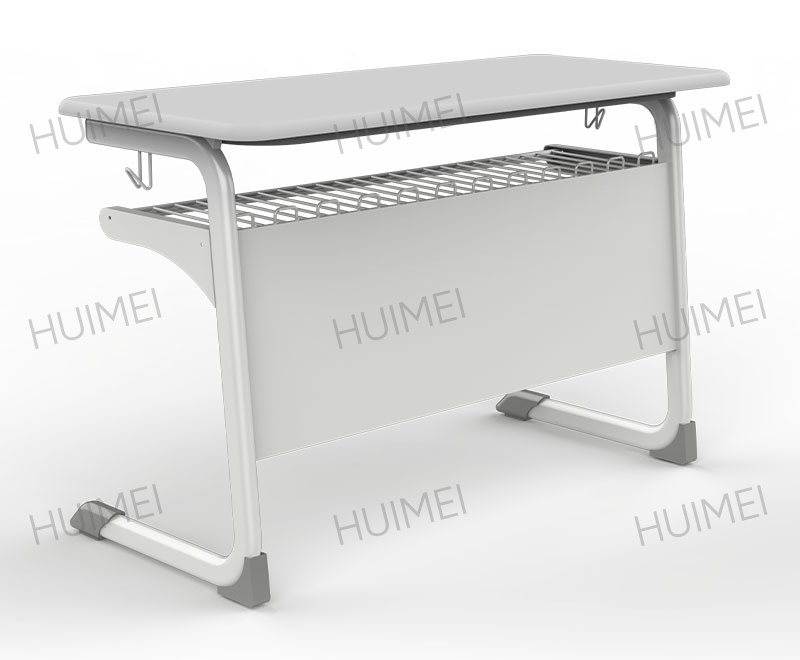 Huimei Library Reading Table and Desk SeriesLong shared reading tables with shelf and secure book storage, including single, double, cart, platform, and whiteboard configurations for libraries.View Product →
After-school and multipurpose rooms
These rooms change function every hour, so the table should move and the bulk storage should stay put. Under-table tubs carry the materials of the moment. Fixed shelving carries everything else, keeping the floor clear and giving the room a fast way to tidy up.
Safety, durability, and cleaning checks
Storage turns a flat table into a piece of equipment with moving parts, and moving parts change the risk profile. The checks below decide whether the table survives a five year replacement cycle.
- Pinch points: drawer and door gaps should either stay under 5 mm or open beyond 12 mm. The range between those figures traps small fingers.
- Tip-over: a 25 kg child can climb onto an open drawer. Confirm frame width and ballast, and fix wall-adjacent units to the wall.
- Edges: a minimum 2 mm radius on top edges and corners, with no exposed screw threads anywhere under the top.
- Moisture: sealed edges on every face of a particleboard core. One unsealed edge under a spill-prone table is enough to swell a top within a term.
- Hardware: threaded inserts rather than screws driven straight into board, and runners rated above the load you actually expect.
- Cleaning: removable containers and a top that tolerates mild detergent. Solvent cleaners will dull most laminate finishes.
It is reasonable to ask a supplier to explain the manufacturing and technical capabilities behind a product, particularly how edges are sealed and how the metal finish is applied. A manufacturer that runs its own steel forming, woodworking, and coating lines can hold those two variables to a tolerance. Suppliers who assemble from bought-in parts have less control over both, and edge sealing is the first thing to fail in a wet room.
What to put in the specification
- Intended room and user age for each table, listed separately when one order covers several rooms.
- Seat count and top dimensions, with a height range if the table is adjustable.
- Storage type, internal dimensions of each container, and load per container.
- Mobility requirement and the floor type the table will run on.
- Edge banding thickness, corner radius, and surface finish.
- Frame material, coating process, and warranty terms on moving parts.
- Cleaning method and chemicals to avoid.
- Spare tubs, runners, and casters available as separate line items.
- A sample table for trial use before the full order is released.
The last item matters more than it looks. A single trial table used for a full term, in the room where it will actually live, reveals which containers get opened, which drawers stay shut, and which fixings loosen. That information is worth more than any catalogue photograph.
Questions buyers ask most often
Can storage be added to a plain activity table later?
Sometimes, but the result is rarely as tidy as a table designed for it. Bolt-on containers need fixing points in the frame, and a frame designed without them usually lacks the rail depth or the screw positions. If storage is likely to be needed within two years, buy it with the table.
How much storage does one activity table need?
Enough for the materials used in a single session, plus a small margin. Storage sized for a whole term of supplies becomes a filing cabinet under a work surface, and children stop using it.
What is the difference between table storage and a storage cart?
Built-in storage travels with the work surface and keeps the floor clear. A separate cart offers more capacity and can be shared between tables, but it takes floor space and needs a clear route through the room. Many rooms end up with both, which is fine as long as the specification accounts for it.
An activity table with storage is a compromise between three things: how much has to be held, how much legroom has to be left, and how much weight has to be moved. Getting the storage type right first, then the dimensions, then the frame and finish, keeps that compromise visible and manageable.
In practice that means writing container dimensions, knee clearance, load ratings, and spare-part availability into the order, and holding the delivered goods to those numbers. Tables are replaced because of their storage far more often than because of their tabletops.
Copyright© Zhejiang Huimei Industry & Trade Co., Ltd. All Rights Reserved.
Professional School Furniture Manufacturer School Furniture Supplier